Tag Archives: Ian Paisley

When Jill and Leon Uris went to Ireland

Fifty years ago this month the American book publisher Doubleday released Ireland: A Terrible Beauty, by Jill and Leon Uris. The couple had traveled on both sides of the partitioned island from May 1972 (four months after Bloody Sunday) to January 1973.

Original dusk jacket.

Leon, an established author, conducted research for a new novel, Trinity, which became a best seller when it was released in 1976. Jill, his third wife, 23 years younger, photographed nearly 400 images of thatched cottages, mist-shrouded countryside, and gritty scenes of urban violence; in color, and in black and white.

Their Preface says:

“We were lured there by an intriguing people, their sometimes magnificent, sometimes harsh land, and, mostly, their poignant history. Our aim was to find the keys to that story which would clarify so much of the mystery and puzzlement of recent events and simultaneously photograph everyone and everything wherever the search took us. …

“Ireland is too vast and complex in its story for two people to cover it comprehensively in less than a decade. We made no pretense at attempting to.

“What we do have here is a social, historical, and political commentary on what we consider to be the guts of the matter of a unique people and their lovely but sorrowed island. This is our point of view on the “troubles” that have plagued Ireland for the fatter part of a millennium.”[1]Leon Uris and Jill Uris, Ireland: A Terrible Beauty. The Story  of Ireland Today (With 388 Photographs, Including 108 in Full Color). [Garden City, New York: Doubleday & Company, Inc., 1975]. … Continue reading

The couple covered 10,000 miles, mostly by auto, “on some decent and some indecent roads.” Their journey and their book recalled American photographer and antiquarian Wallace Nutting, who estimated he and his wife covered 700 miles in all 32 counties 50 years earlier, during the summer of 1925. Nutting’s book, Ireland Beautiful, was published in time for that year’s Christmas gift-giving. It featured 304 half-tone engravings of Irish landscapes—only six images show people—and his text in support of the title.

From his studio near Boston, Nutting wrote:

“This volume pretends to no place as a guide book, nor is its text intended to cover with precision or fullness any part of Ireland. It is merely a record of impression of beauty or quaintness, observed in a land which for romance and pathos, strange history and legend, for witching grace and mystery, is probably unsurpassed.”[2]Wallace Nutting, Ireland Beautiful. [Norwood, Mass.: The Plimpton Press, 1925]. 302 pp. Quoted from Foreword.

Though he began his career as a Congregationalist minister, Nutting insisted his book had “nothing whatever to do with political and religious matters.” He noted the work of the Boundary Commission, which later in 1925 fixed the partition line in place, and made sweeping, uncontroversial generalizations: “The people of Ulster were as insistent on remaining in the empire as South Ireland was on withdrawing from the empire.”[3]Ibid., 286.

For more on Nutting, see my August 2025 piece for History Ireland, “Ireland Beautiful–How A 1925 American Photobook Boosted Irish Tourism.”

More opinionated

Leon Uris was more opinionated in his analysis of an Ireland then descending deeper into sectarian strife, rather than the island emerging from the war of independence and civil war at Nutting’s visit. During the Uris’s nine-month stay, more than 400 people were killed and thousands of others were injured in shootings and bombings. More than 500 people were charged with terrorist offences. “Their visit coincided with one of the most violent years of the Troubles,” wrote biographer Ira B. Nadel.[4]Ira B. Nadel, Leon Uris: Life of a Best Seller. [Austin: University of Texas Press, 2010], See Chapter 9, “Ireland,” 209-232.

Uris leveraged his identity as an American Jew, not an Irish-American of Catholic or Protestant faith, as well as his status as a celebrity author. He took particular aim at “the most diabolic by-product of three hundred and fifty years of the plantation of Ulster, a cancerous growth known as Paisleyism.” Grimly, he concluded: “The nightmare of Ulster has come about with Christian fighting Christian in one of the most advanced of Western societies. Continuation of this travesty with God can lead to the eclipse of civilization in that part of the world.”[5]Uris, Terrible Beauty, 128, 195.

The Troubles got much worse, of course, but not quite that bad.

By coincidence, Terrible Beauty’s November 1975 release was three months after the death of Éamon de Valera, the most consequential leader of twentieth century Ireland. The book says he “had the full measure of that detached, ruthless arrogance, political guile, persuasiveness, and total self-assurance that stamp greatness on a national leader. He was the rarest breed, the head of a small country that has achieved stature among the political giants of this century.”[6]Ibid., 162.

Photographing Ireland

Dev’s death ends the book’s 8-page chronology, which begins at 10,000 BC when the island emerged from the receding Ice Age. Naturally, the book included a map and, like the island itself, was divided into two sections: The Republic and Ulster.

“Photographing in the Republic was almost always a joy. Ulster was another story,” Jill Uris wrote. She described the difficulties of working as a woman and an outsider in the sectarian maelstrom of the North. Her “Photographing Ireland” in the Appendix also contains notes about the pre-digital camera equipment she used during the assignment.[7]Ibid., 209-212

Aside from the images of sectarian violence in the North, most of Jill’s photographs show a mid-twentieth century Ireland without much hint of the rapid modernization that emerged in the coming decades, and certainly since 2000. In this regard her images of the country are similar to those of American photographer Dorothea Lange, who arrived in County Clare in September 1954 on an assignment for Life magazine. See my September 2024 post, “Remembering Dorothea Lange’s ‘Irish Country People’“.

I’ll return to my exploration of the Uris’s visit and their work in future posts.

References

References
1 Leon Uris and Jill Uris, Ireland: A Terrible Beauty. The Story  of Ireland Today (With 388 Photographs, Including 108 in Full Color). [Garden City, New York: Doubleday & Company, Inc., 1975]. 288 pp.
2 Wallace Nutting, Ireland Beautiful. [Norwood, Mass.: The Plimpton Press, 1925]. 302 pp. Quoted from Foreword.
3 Ibid., 286.
4 Ira B. Nadel, Leon Uris: Life of a Best Seller. [Austin: University of Texas Press, 2010], See Chapter 9, “Ireland,” 209-232.
5 Uris, Terrible Beauty, 128, 195.
6 Ibid., 162.
7 Ibid., 209-212

On Pope Leo, King Charles, and Soldier F

As voters in the Republic of Ireland selected a new president, two news stories with deep connections to Northern Ireland also made headlines this month:

  • Britain’s King Charles III prayed with Pope Leo XIV at the Vatican’s Sistine Chapel, the first joint worship of the English monarch and the Catholic pontiff since King Henry VIII broke away from Rome in 1534.
  • “Soldier F,” a former member of the British Parachute Regiment, was found not guilty of murder and attempted murder for Bloody Sunday, 1972, in Derry (Londonderry), Northern Ireland.

As king, Charles is also supreme governor of the Church of England. He has met previous popes, but never prayed with them in public. “This would have been impossible just a generation ago,” Anglican Rev. James Hawkey, canon theologian of Westminster Abbey, told Reuters. “It represents how far our churches have come over the last 60 years of dialogue.”

Pope Leo and King Charles in the Sistine Chapel. Photo www.royal.uk.

In Northern Ireland, however, some Orangemen turned red with rage. “A sad day for Protestantism,” the fraternal group said. Rev. Kyle Paisley, son of the late unionist leader Ian Paisley, and other Protestant clergy condemned the visit. Paisley even suggested that Charles should abdicate the throne.

In 1988 Paisley’s father infamously interrupted Pope John Paul II during the pontiff’s address to the European Parliament. “I denounce you, antichrist. I refuse you as Christ’s enemy and antichrist with all your false doctrine,” shouted Paisley, firebrand founder of the Free Presbyterian Church. It was hardly his only anti-Catholic stunt.

Of course, religious prejudice can cut both ways. Defeated Irish presidential candidate Heather Humphreys, an Ulster Presbyterian whose husbanded once belonged to the Orange Order, told the Irish Times that she and her family “were subjected to some absolutely awful sectarian abuse” during the campaign.

Most people in Northern Ireland seem to have accepted the rapprochement between Leo and Charles with a shrug. Not that we are likely to see Belfast “Kick the Pope” bands suddenly replaced by ecumenical choirs. Sectarianism waxes and wanes, but it seldom disappears.

Bloody Sunday verdict

Thirteen people were shot dead and at least 15 others injured Jan. 30, 1972, at a civil rights demonstration in the Bogside area of Derry. Fifty-three years later Judge Patrick Lynch of the Belfast Crown Court said members of the Parachute Regiment “totally lost all sense of military discipline” and shot “unarmed civilians fleeing from them on the streets of a British city,” according to reporting by the BBC.

The 1972 civil rights demonstration in Derry, Northern Ireland, that became Bloody Sunday.

But the evidence against Soldier F, whose anonymity is protected by a court order, fell short of what is required for conviction, Judge Lynch ruled in the non-jury trial.

Reaction to the decision was predictably split along the usual republican and unionist lines. “Deeply disappointing” and “continued denial of justice”, said First Minister Michelle O’Neill of Sinn Féin. Democratic Unionist Party leader Gavin Robinson welcomed the “common sense judgement”, but said the trial had been “a painful and protracted process,” according to BBC.

The US-based Ancient Order of Hibernians, a Catholic fraternal group, issued a statement saying it was “saddened but not surprised” by the acquittal. “As we have for decades, the AOH will support the Bloody Sunday families as they take the next steps in their fight for justice, and we will stand with all victims’ relatives as they continue their fight for legacy truth.”

In 2010, then British Prime Minister David Cameron formally apologized for Bloody Sunday. The judges verdict is unlikely to be the last word on the matter, which has become the life’s work of the victims’ surviving family members and others on one side, with British veterans groups and hardline unionists on the other.

See my 2022 History News Network piece on the 50th anniversary of Bloody Sunday.

Guest post: Journalists recall coverage challenges during Northern Ireland Troubles

Daniel Carey is a PhD student at Dublin City University. His thesis examines the working lives of former journalists and editors in Ireland. I’ve had the pleasure of reading his work and hearing Dan present some of his research at Newspaper and Periodical History Forum of Ireland conferences. He is based at University College Dublin, where he works as research project officer for community engagement at CUPHAT. Find him on Twitter @danielmcarey. … Journalists, historians, authors, researchers, and travelers to Ireland are always welcome to offer guest contributionsMH

***

On his first night working in Belfast in late 1969, Irish Times reporter Conor Brady met his colleague Henry Kelly, who wrote on the back of Brady’s hand: “S = P; F = C”. That important piece of shorthand stood for “Shankill [Road] equals Protestants, Falls [Road] equals Catholics”. Dublin-based reporters like Brady “hadn’t a clue” about the geographical specifics of Northern Ireland at that time, he acknowledged, and he laughed ruefully when reflecting on the “guidance” he received from Kelly.

Brady, who later became editor of the Irish Times, was one of  30 people I interviewed for my PhD thesis. Many of them covered the Northern Troubles, which proved a formative experience for generations of Irish journalists. Fifty years on from Bloody Sunday in Derry and Bloody Friday in Belfast, the success of Sinn Féin in the May 2022 Assembly elections brought Northern Ireland back into the international headlines. But the days when Belfast hotels such as the Europa were regularly filled with correspondents from The New York Times, Agence-France Presse, and various German newspapers are no more.

Lyra McKee was killed in Derry, this mural is in Belfast, her native city.

The murder in 2019 of Lyra McKee in Derry brought into sharp relief the dangers faced by reporters in Northern Ireland today. Journalists who covered the Troubles faced intimidation and threats to their personal safety. But at least in some cases, journalists may have been safer than ordinary civilians, in an era when many paramilitaries felt harming reporters would be counterproductive.

Michael Foley of the Irish Times remembers travelling in a car during the Troubles when he and a colleague were stopped at a barricade patrolled by individuals armed with Armalite rifles. Foley’s outraged companion yelled: “How dare you stop us! We’re journalists!” and showed his National Union of Journalists membership card. This prompted an apology from one of the armed men, who, Foley remembers, “didn’t want us to tell Danny Morrison, who was the Sinn Féin press officer at the time”.

Emily O’Reilly says she “actually never felt unsafe” while covering Northern Ireland for the Sunday Tribune. She “knew that journalists were generally safe in the North” and felt that women “got an extra layer of protection”. In 1984, a Democratic Unionist Party [DUP] politician named George Seawright told a meeting of the Belfast Education and Library Board that Catholics who objected to the playing of the British national anthem at mixed concerts for school children were “Fenian scum” who should be incinerated, along with their priests.

Showing what she called “the fearlessness of youth”, O’Reilly rang Seawright and asked for an interview. He readily agreed and invited her to his maisonette home on the Forthriver Road in Belfast. She wandered into what she called “a wonderful oasis of domesticity”, where Seawright was “the personification of charm” and “just lovely”. She remembers him seeing her off at the door by joking: “Wouldn’t it be hilarious if you got shot here?”

Emily O’Reilly

She arranged to meet Seawright again the following day, where they were joined by a man named John Bingham, a member of the Ulster Volunteer Force [UVF] who had been sentenced to 20 years in prison on “supergrass” evidence [from an informant in exchange for immunity] before his conviction was overturned. The trio did what she called “a tourist trip” around the Shankill Road area, with Bingham showing what she said was “an incredibly detailed knowledge” of where people had died violently. Both Bingham and Seawright were themselves subsequently shot dead.

Andy Pollak, son of a Czech Jewish father and a Protestant mother from Ballymena, County Antrim, edited Fortnight magazine in Belfast from 1981 to 1985. He “very rarely had any trouble” in Northern Ireland. But one exception came in the mid-1980s, when he was researching a book which he was co-writing with fellow journalist Ed Moloney on DUP leader Ian Paisley.

“We wanted to find a place … away from the mainstream, where Paisley was talking to his own people, with no media,” Pollak explains. “He was doing a series of … rallies around the place, and he was in Pomeroy [in County Tyrone], and I went down. There was no other journalist there, and … he gave his rabble-rousing speech. And there were bandsmen, and one of them asked me … ‘Who are you?’ and I said ‘I’m from the Irish Times’ … which was a mistake. So anyway, they started to kind of duff me up and beat me up, you know, [they called me a] ‘fuckin’ Fenian’ and all this sort of stuff, and I was rescued by the RUC [Royal Ulster Constabulary] … The RUC man said: ‘You’ve got a bit of blood on your collar, you could claim for that’ So I came … away eventually three hundred pounds richer … from that trip!”

Such episodes of intimidation were not confined to Northern Ireland. Husband and wife Michael O’Toole and Maureen Browne covered a lot of kidnapping stories for the Daily Telegraph and the Daily Mail, and, Browne recalls, “ran into trouble with the IRA” as a result. A petrol bomb thrown at Browne in the Dublin suburb of Portmarnock only narrowly missed its target. Threats against the couple’s children prompted O’Toole to see “the leaders of the organisation” and “the dogs of war were called off”.

The Troubles constitute a small but important slice of the material collected for the project. The thesis researches journalism as a career choice and investigates the relationship between Irish journalism and politics, religion and technology. Recordings of the 30 broad-ranging interviews will become part of the Media History Collection at Dublin City University, where they will be made available for public access and may form part of future exhibitions.

The Europa Belfast, a regular lodging place for correspondents during the Troubles, was considered “the most bombed hotel” in Europe. Despite 33 blasts, nobody was killed, according to the new book, ‘War Hotels’. 2019 photo by MH.

A Journey In Ireland, 1921, Revisited: Ulster attitude

Novelist and journalist Wilfrid Ewart traveled through Ireland from mid-April to early May 1921. His dispatches for London newspapers were later collected and revised in the book, ‘A Journey in Ireland, 1921.’ Previous installments of this centenary series are collected at American Reporting of Irish Independence.

***

In their “Introduction” to the 2009 UCD Press edition of Journey, Paul Bew and Patrick Maume devote considerable attention to Ewart’s time in what today is Northern Ireland. They note the author’s reference to his September 1913 visit to an Ulster Volunteer Force rally in Newry. It is unclear, they comment, whether Ewart, then 21, “was there for political sympathy, personal connection with the participants, or journalistic curiosity, though he speaks of ‘marching with the Covenanters’ which implies a certain degree of participation.”[1]“Introduction”, Journey, UCD Press edition, 2009, pp.xii-xiii. A year earlier, unionists signed the Ulster Covenant to protest Ireland leaving the United Kingdom under home rule, as proposed at the time.

Ewart’s material from his 1921 visit to Belfast, Bew/Maume continue, “is perhaps the most fascinating in the book,” and they provide considerable analysis of the events he covers.[2]Ibid, p. xvii. The author arrives in the northeast portion of Ireland as Ulster Unionist chief James Craig meets with Sinn Féin leader Eamon de Valera, and three weeks before the first general election of the new Northern Ireland parliament.

“All Befast was talking of the Craig-de Valera meeting, girding itself with an illusive expectancy, girding sometimes at its own leader [Craig], tending to lose sight of the major question in the momentary issue,” Ewart writes.[3]Journey, p. 156.

This meeting and the outcome of the election are well documented. More striking 100 years later is the unchanged and unmistakable political and cultural attitude of the region Ewart describes in Journey. It is personified by Sir Dawson Bates, then secretary of the Irish Unionist Alliance, “a downright hardheaded zealot, with a clear-cut horizon and no sentiment to spare,” Ewart says. “He speaks and looks and thinks and is–Belfast.”

At the Orange hall rally Ewart attends in East Belfast, Bates bellows:

We don’t want a United Ireland, we want a United Kingdom. … Some people hope that Ulster is going to make a mess of things. Failure means handing our bodies and souls over to Sinn Féin and the Roman Catholic Church. We’ve had enough of Dublin in the past. If we can crush Sinn Féin at the forthcoming elections, there’s a bright future for Ulster.[4]Journey, p.152-153.

A month later, Bates became Northern Ireland’s first minister for home affairs, a post he held for nearly 22 years. “His conspicuous distrust of the nationalist minority frustrated initial attempts to secure its cooperation, helped to minimize its power in local government, and encouraged an overtly discriminatory administrative style,” the Dictionary of Irish Biography says.[5]See Bates, Sir (Richard) Dawson, by Richard Hawkins, Dictionary of Irish Biography.

Northern Ireland Cabinet, 1921. Sir Dawson Bates at left, James Craig third from left. Others, l. to r, are Marquess of Londonderry, Hugh McDowell Pollock, E. M. Archdale, and J. M. Andrews. Ewart interviewed Pollock, who was finance minister.

Ewart also interviews finance minister-designated Hugh McDowell Pollock,  whom he characterizes as uncompromising and inflexible, a man who “can hardly be described as concessionable.” Pollock proclaims, “English people are stupid” because they fail to see that Ulster is “the only bulwark between them and the complete dissolution of the British Empire.” The people of southern Ireland, he says, are “full of sentimental ideas about nationalism.”[6]Journey, pp. 235-237. Also cited by Maurice Walsh, Bitter Freedom: Ireland in the Revolutionary World. W. W. Norton & Co., New York,  2015, pp. 306-307.

Bew/Maume detail how Ewart selectively reports “his vision of Ulster Unionist intransigence” by excluding moderate portions of the Craig speech he attends. They suggest Ewart was “more at home with the wistful and fearful Southern Unionists” who were willing to accept some form of Dominion status than the “more confident and intransigent” Ulstermen.[7]“Introduction”, p. xviii, and p. xiv.

The attitude expressed by Bates and Pollock prevailed in the region from the 1912 Ulster Covenant through the sectarian Troubles of the late 20th century, when it was personified by Ian Paisley. True, Paisley moderated his views after the Good Friday Agreement of 1998, even developed an unlikely partnership with Irish republican Martin McGuinness. Echoes of Bates and Pollock reverberate in current outcries over Brexit’s impact on the region and increased talk of a united Ireland. More hard-line rhetoric is likely to be heard in the months ahead as the Democratic Unionist Party’s replaces resigned leader Arlene Foster.  

The next post in this series will catalog more of Ewart’s interview quotes from Belfast and other parts of Ireland on the two key subjects: the island’s 1921 partition, and the Easter Rising that preceded it in 1916.

Curious errors

In his chapters about Northern Ireland, Ewart’s book contains two historical errors: 

Cecil Doughty image of the 1882 Phoenix Park murders.

He suggests the first deaths of the Irish War of Independence, the Jan. 21, 1919, ambush of RIC officers James McDonnell and Patrick O’Connell at Soloheadbeg, County Tipperary, shared an anniversary date with the murders of Lord Frederick Cavendish and Thomas Henry Burke in Dublin’s Phoenix Park.[8]Journey, p. 143.

This is incorrect. The Dublin killings occurred nearly 40 years early, on May 6, 1882, during Ireland’s Land War period. 

A few pages later, Ewart quotes an unnamed “high official” in Belfast who criticizes de Valera, citing the quote: “If the Unionists do not come in on our side they will have to go under.” Ewart, in parentheses, attributes the comment to a July 5, 1919, speech at Killaloe, County Clare.

This place and date are correct, but the year was 1917, as de Valera campaigned in a special by-election for the seat opened by the death of Irish Parliamentary Party incumbent Willie Redmond. The Sinn Féin candidate won in a landslide five days later. Two years later, De Valera was in the early weeks of his 18-month tour of America to raise money and political support of the Irish republic.

As with most fact errors–and I have made my share–it is not so remarkable that mistakes were made in the first place, but that they survived the copy editing of other readers before publication.

NEXT: Rising & Partition

References

References
1 “Introduction”, Journey, UCD Press edition, 2009, pp.xii-xiii.
2 Ibid, p. xvii.
3 Journey, p. 156.
4 Journey, p.152-153.
5 See Bates, Sir (Richard) Dawson, by Richard Hawkins, Dictionary of Irish Biography.
6 Journey, pp. 235-237. Also cited by Maurice Walsh, Bitter Freedom: Ireland in the Revolutionary World. W. W. Norton & Co., New York,  2015, pp. 306-307.
7 “Introduction”, p. xviii, and p. xiv.
8 Journey, p. 143.

Catching up with modern Ireland: June

We’ve reached the halfway point of 2019. My monthly roundup follows below. I will be in Ireland from late July through early August, posting about my travels. The monthly round up will return at the end of August. MH

  • My piece on Éamon de Valera‘s 1919 visit to Louisville, Kentucky, where he was drawn by up-and-coming caricaturist Wyncie King, was published on The Filson Historical Society Blog. The accompanying watercolor image probably has not been seen in 100 years.
  • Edward F. Crawford, 81, a wealthy Ohio businessman, was sworn in as the new U.S. ambassador to Ireland, more than two years after the Trump administration came into office.
  • “So let’s not wrap the death of “rural Ireland” in a shroud of nostalgia. Piety has never done the real rural Ireland any good. Dying worlds attract romantics and since “rural Ireland” has been dying for 170 years, it has been romanticised up to its neck,” Fintan O’Toole writes in a column for The Irish Times, part of a five-story exploration of rural Ireland.
  • New “mortality differentials” from the Central Statistics Office show Irish women live longer than men; marrieds longer than singles; professionals longer than unskilled workers; and Protestants longer than Catholics.
  • Fodor’s is dropping online and print references to Belfast’s political murals after the BBC suggested it guides pandered to damaging, unhelpful and unfair stereotypes of unionists. The guides described Catholic murals as “wildly romantic” and “aspire to the heights of Sistine Chapel-lite” while Protestant murals “resemble war comics without the humor.” The guides also said, “In Northern Ireland they say the Protestants make the money and the Catholics make the art.”

“King Billy” mural in Belfast, from my 2016 visit.

  • The Conflict Archive on the Internet (CAIN) has secured one year of operational funding while it continues to look for long-term support. Ulster University announced earlier this year it was closing the highly-respected source of information about the Troubles and politics in Northern Ireland, drawing the ire of journalists, historians, and others.
  • Ivan Cooper, a founding member of the Social Democratic and Labour Party (SDLP) and civil rights leader in Northern Ireland, died at age 75.
  • TheJournal.ie has introduced an “Ireland 2029” podcast. The first episode explored whether Ireland (and the rest of the world) is ready for a four-day work week.
  • “A previously confidential government study detailing 142 areas of life in Northern Ireland that will be impacted by Brexit has been published, revealing risks to everything from cooperation on congenital heart disease and cross-border child protection to rules preventing the looting of national treasures,” The Guardian reported.
  • Niall Gibbons, the chief executive of Tourism Ireland, has rejected claims by the DUP’s Ian Paisley that the marketing agency favors the Republic of Ireland over Northern Ireland. Read Gibbons’ statement to the Northern Ireland Affairs Committee at Westminster.
  • Arranmore Island, three miles off the coast of County Donegal, is trying to attract immigrants to boost its dwindling population of fewer than 500 people. The community council is promoting the island’s high-speed internet service and laid-back lifestyle will attract knowledge workers to the remote local.

Árainn Mhór Island

Ireland Under Coercion, Revisited: Home Rule

This blog serial explored the 1888 book Ireland Under Coercion: The Diary of an American, by journalist William Henry Hurlbert. Previous posts and background material are available at the project landing page#IUCRevisited 

***

“It is not in accordance with the American doctrine of ‘Home Rule’ that ‘Home Rule’ of any sort for Ireland should be organized in New York or in Chicago by expatriated Irishmen.”
–William Henry Hurlbert

In the early 1880s, agrarian agitator Michael Davitt and Irish Parliamentary Party leader Charles Stewart Parnell partnered in an bid to secure domestic political autonomy for Ireland–Home Rule. The effort got financial and political support from the Irish in America, roused by visits from Davitt and Parnell. Despite the support of Liberal British Prime Minister William Ewart Gladstone, however, the legislation was defeated by unionists in 1886, two years before Hurlbert’s arrival in Ireland.

Charles Stewart Parnell

Hurlbert wrote the 1886 bill would have made Gladstone and the British government “the ally and the instrument of Mr. Parnell in carrying out the plans of Mr. Davitt, Mr. Henry George, and the active Irish organizations of the United States.” Hurlbert also recognized the Home Rule effort was not over:

“How or by whom Ireland shall be governed concerns me only in so far as the government of Ireland may affect the character and the tendencies of the Irish people, and thereby, the close, intimate, and increasing connection between the Irish people and the people of the United States, may tend to affect the future of my country. … [In the wake of the failed 1886 bill] ‘Home Rule for Ireland’ is not now a plan–nor so much as a proposition. It is merely a polemical phrase, of little importance to persons really interested in the condition of Ireland, however invaluable it may be to the makers of party platforms in my own country, or to Parliamentary candidates on this side of the Atlantic. … [It] has unquestionably been the aim of every active Irish organization in the United States for the last twenty years … [and] Parnell is understood in America to have pledged himself that he will do anything to further and nothing to impede.”

Within months of Hurlbert’s visit to Ireland, Parnell would face a special commission called to investigate his alleged links to two 1882 political murders. Though cleared two years later, he soon was scandalized by revelations of his extramarital affair with the wife of one of his parliamentary colleagues. He died in 1891, two years before a second Home Rule bill was raised (and defeated) in parliament.

Col. Edward James Saunderson

During his second and third days in Dublin, Hurlbert met with several members of the British administration and M.P.s who opposed any form of separation of Ireland from the United Kingdom. An unidentified Catholic unionist from southern Ireland told him it would be “madness to hand Ireland over to the Home Rule of the ‘uncrowned king’ (Parnell’s nickname).”

Later, Hurlbert attended a meeting of Irish unionists, where he heard a speech by Colonel Edward James Saunderson. The M.P. for North Armagh (now part of Northern Ireland) asked the audience whether they could ever imagine being governed by “such wretches” as the Parnellite nationalists?

“Never,” the crowd replied in what Hurlbert described as “a low deep growl like the final notice served by a bull-dog.” Ian Paisley and his unionist supporters echoed the response 97 years later outside the Belfast City Hall.

NEXT: Dublin slums

NOTES: This post is based on the Prologue and pages 53 to 70 of Ireland Under Coercion: The Diary of an American

Copyright 2018 by Mark Holan

Northern Ireland ‘Journey’ nears critical bend in road

“The Journey,” a fictional “imagining” of the real-life partnership between unionist firebrand Dr. Ian Paisley and former IRA man Martin McGuinness, recently debuted in Washington, D.C., as part of its wider U.S. release.

The movie isn’t as awful as early reviews suggested last fall, though there is merit to that criticism. It’s worth seeing for those who follow Northern Ireland politics. The long, twisted history of the Troubles, and the actors’ thick accents, are probably too much for more casual viewers.

A line near the end of Colin Bateman’s screenplay caught my attention and could prove to be prescient in the coming weeks. It is spoken by McGuinness (Colm Meaney) to Paisely (Timothy Spall) as they are about to agree on the power-sharing deal that resulted in the 2007 Northern Ireland Assembly:

This is our only opportunity to build something that will last, at least for our lifetime.

The real-life duo got the Assembly off the ground and developed such a close working relationship that they become known as  the chuckle brothers. Peace and progress flourished in Northern Ireland. But Paisley died in September 2014, and McGuinness died in March.

Now, the suspended Belfast Assembly is facing a 29 June deadline to reorganize, or the north could return to direct rule from Westminster. This matter is complicated by the Paisley-founded, pro-unionist DUP entering a Tory coalition to control the London Parliament, which will put Irish republicans on the defensive. This comes as the U.K. also begins to negotiate its exit from the European Union–Brexit–which threatens the return of a “hard border” between the north and the Republic.

At the same time, the annual Orange Order marching season, in which Protestants celebrate a 1690 military victory over Catholics, is getting underway and approaching its 12 July peak. The season always raises tensions between the two cultural and political communities in the north.

What could possibly go wrong?

Critics slam new film on Northern Ireland peace process

“The Journey,” a new film about the unlikely partnership between Sinn Féin’s Martin McGuinness and the late unionist firebrand Rev. Ian Paisley, has debuted to dreadful reviews.

The Hollywood Reporter says “deficiencies in script and direction render the vehicle less than road-worthy.” The movie is “best suited to a mid-evening UK television slot” and “has little hope of big-screen exposure beyond the formerly war-torn province whose history it depicts.”

“The Journey,” according to The Telegraph, is “a graceless Wikipedian plod through the Irish peace process … a tremendously promising idea squandered beyond the limits of human ken.”

Adds The Guardian: “This film feels the need to be fair, to be balanced. That is understandable. But it is tiptoeing on eggshells of its own making.”

The Journey” debuted 7 September at the 73rd Venice International Film Festival. As yet no trailers are posted on YouTube.

Timothy Spall as Ian Paisley, left, and Colm Meaney as Martin McGuinness in "The Journey."

Timothy Spall as Ian Paisley, left, and Colm Meaney as Martin McGuinness in “The Journey.” Below, the real deal.

16/7/2007. Northern Ireland Deputy First Minister, Martin McGuinness, and First Minister, the Rev Ian Paisley, at the press conference at Parliament Buildings, Stormont (Belfast), after their meeting with British Prime Minister Gordon Brown. Pic. Albert Gonzalez/RollingNews.ie

Albert Gonzalez/RollingNews.ie


Brexit creates British rush on Irish passports

How’s this for a post-Brexit eye roll:

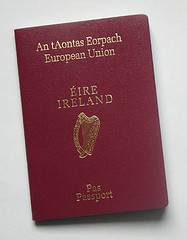
IrishPassport.jpg (187×240)Northern Ireland politician Ian Paisley Jr., son of the late unionist firebrand Dr. Ian Paisley, is advising his constituents to apply for a passport from the Republic of Ireland following Britain’s decision to leave the European Union.

“My advice is if you are entitled to second passport then take one,” Paisley tweeted the day after the referendum vote. “I sign off lots of applications for constituents.”

Paisley, a British MP from North Antrim, opposed the Good Friday Agreement in 1998, though his father became first minister of the power-sharing government it created. Now, Junior–who campaigned for Brexit–opposes calls by Irish republicans to politically reunite the island of Ireland and remain in the EU.

An Irish passport confers the holder with travel and work privileges within the 27-nation EU, which the UK has now voted to leave. People born in any of Ireland’s 32 counties, north or south, or those with a parent or grandparent born on the island, are eligible to apply for a passport from the Republic.

“An unnecessary surge in applications for Irish passports will place significant pressure on the system and on turnaround times and is likely to impact those with a genuine need for passports to facilitate imminent travel plans,” Irish Foreign Affairs Minister Charlie Flanagan said in statement. The ministry issued an updated FAQ on Irish citizenship, passports and residency requirements.

The post-Brexit rush on Irish passports follows a 14 percent increase in applications by U.S. citizens since last summer, which some news accounts have attributed to Donald Trump’s hold on the GOP presidential nomination.

Glad I claimed my Irish citizenship and passport 19 years ago.


Popular broadcaster Terry Wogan dies at 77

Sir Terry Wogan, a Limerick-born star of the British Broadcasting Corporation, died 31 January after a short bout with cancer. He was 77. Read the BBC’s obituary.

Terry-Wogan-008.jpg (460×276)

In The Guardian, Martin Kettle writes that Wogan rarely drew explicit attention to his Irishness.

And yet, although he lived, worked and died in Britain, was knighted by the Queen, and was never reluctant to wave the union jack when the needs of the BBC required it, his Irishness was there whenever he opened his mouth. For more than 40 years he was probably the most prominent Irish person, and certainly the most familiar Irish voice, in Britain, rivaled for fame only by [footballer] George Best and Bono, neither of whom could match Wogan’s length of time in the spotlight.

…Whether he liked it or not, Wogan was a significant Irish presence in Britain right through the era of Gerry Adams and Ian Paisley. To some Irish nationalist eyes that may perhaps brand him as someone who made dubious accommodations with Britishness at a sensitive time. To his British listeners, however, and possibly to many of his Irish ones too, Wogan was a reminder that there was also much more to the British-Irish relationship than nationalist and loyalist politics, and that people on both sides of the Irish Sea have more in common than some of them sometimes like to pretend.

Irish Times columnist Martin Doyle wrote that “Ireland has had no finer ambassador to Britain.” Irish Taoiseach Enda Kenny said Wogan “acted in no small way as a bridge between Ireland and Britain.”