Guest post: Outrage over inclusion of IRA in new video game

Timothy Plum has been traveling to Ireland for more than 20 years on business, academic and personal reasons. His last guest post for this blog was about Brexit. MH

***

The latest iteration of the “Mafia” video game series, which references IRA violence, is drawing criticism in Northern Ireland for trivializing the Troubles.

“Mafia III” is set in 1968 in a recreation of New Orleans. The player is on a quest to build a new crime organization to confront the Italian mob over the killings of his friends. Players game through the third-person perspective of fictional orphan and Vietnam War vet Lincoln Clay.

In a segment titled “The IRA Don’t Ask,” Clay’s mission includes stealing cars for an Irish underboss named Thomas Burke. The cars are destined for use as car bombs meant to “keep the Belfast law guessing.” The game also includes a Northern Ireland flag defaced with the word “traitor.”

Screen grab from "Mafia III" by 2K Games.

Screen grab from “Mafia III” by 2K Games.

The game uses stereotypes to glorify the IRA, including drunkenness, rowdiness and extreme violence. Using a time period as fresh and raw as 1960’s Northern Ireland, in my opinion, is a disservice to gamers–most of whom will have no idea of the actual events–and the public at large.

Unionist politicians have condemned the game. DUP MP Jeffrey Donaldson told The Irish News that he is “very concerned” about the impact the game could have on “impressionable” minds. “The IRA were a terrorist organisation that murdered very many innocent men, women and children in Northern Ireland and other parts of the UK.”

As of 15 October, news coverage from the North has not included any reaction to the game from Sinn Féin or other nationalists.

So far, “Mafia III” has been poorly received by the gaming community, so perhaps the damage of misunderstanding and myth perpetuation will be tamped down by poor sales. But it is sad to have the past dredged up in such a poor fashion that only perpetuates stereotypes and does not further discussion.

The Irish in America: racists, or not?

Shortly after my last post about the vice presidential debate, Irish Times columnist Brian Boyd complained that Democrat Tim Kaine “invoked the historical discrimination towards the Irish in the U.S. to highlight the Republican Mike Pence’s support for Donald Trump’s inflammatory views on immigrants.”

But “the Irish in America were inglorious bastards,” he wrote, citing examples of Irish hostility toward African-Americans from the Civil War period to the busing crisis in Boston.

Now, the Times has published a counter column by Niall O’Dowd, founder of Irish Voice, Irish America Magazine and IrishCentral.com.

“There are actually no absolute judgements which makes us as a race in Ireland and America both saints and sinners. That is what objective history teaches, not single issue demonization.”


Irish immigrants cited in veep debate

Virginia Sen. Tim Kaine (D) made two Irish references in his 4 October vice presidential debate against Indiana Gov. Mike Pence (R). Kaine is Hillary Clinton’s running mate, Pence is paired with Donald Trump.

Kaine’s quotes, from the Vox debate transcript:

…we are a nation of immigrants. Mike Pence and I are both descendants from immigrant families. Some things, you know, maybe said weren’t so great about the Irish when we came in, but we [were] absorbed, and made our nation stronger. When Donald Trump said Mexicans are rapists and criminals, he said the judge was unqualified to hear a case because his parents were Mexican. I cannot imagine how you could defend that.

***

I grew up with a great Irish Catholic council. I was educated by Jesuits. I worked with Jesuit missionaries in Honduras now nearly 35 years ago and they were the heroes of my life.

Pence also grew up in an Irish Catholic family. As I reported earlier this year in the Pittsburgh Post-Gazette, he has family ties to Doonbeg, County Clare, where Trump owns a golf course. Kaine’s ancestors were from counties Longford and Kilkenny.

Astute readers will remember that Irishness was raised at the vice presidential debate four years ago between Joe Biden and Paul Ryan.

TimKaine.JPG (1400×933)

Irish American museums, libraries and cultural centers

UPDATE: Readers have helped add several names to the list below. Thanks! I’ll soon create a permanent home for this information on the menu at the top of the blog. Keep those contributions coming. MH

The Irish American Museum of Washington, D.C. has not responded to my email asking for an update on the proposed project, which I raised in a recent post pegged to the opening of the National Museum of African American History & Culture. Someone at the @DCIRISHMUSEUM Twitter account offered links to the virtual museum’s online posts about President Barack Obama and the late boxing great Muhammad Ali, suggesting it “shares profound history” with the NMAAHC.

On Facebook, one of my former Mobile Press-Register colleagues asked: “Do Boston or NYC have such museums? It would seem they would considering how important they were to the formation of both those cities.”

That’s a great question, one that reaches beyond those two cities and the DC Irish American Museum effort. The information below is the beginning of an answer. It is not a complete list. I’m hoping readers will let me know about other U.S. museums, libraries, cultural centers and programs devoted to Irish ancestry and contemporary connections. (List is in alphabetical order by location.)

Irish American Heritage Museum, Albany, N.Y.

Irish Railroad Workers Museum, Baltimore, Md.

Center for Irish Programs, Boston College, Boston

Irish Cultural Center of New England, Canton, Mass.

Irish American Heritage Center, Chicago

Irish Collections, The Newsberry Independent Research Library, Chicago

Ireland’s Great Hunger Museum, Hamden, Conn.

Irish Cultural Museum of New Orleans, New Orleans

Glucksman Ireland House, New York University, New York City

Irish American Historical Society, New York City

Irish Arts Center, New York City

Omaha Irish Cultural Center, Omaha, Neb.

Irish Heritage Theatre, Philadelphia

Philadelphia Irish Center, Philadelphia

Irish Cultural Center & McClelland Library, Phoenix

Irish Centre of Pittsburgh, Pittsburgh

Irish Nationality Room, University of Pittsburgh, Pittsburgh

Irish Cultural Center of California, San Francisco

Embassy of Ireland, Washington, D.C., plus Consul General offices in six cities and honorary consulates in 11 cities.

Fenian Brotherhood Records and O’Donovan Rossa Personal Papers, and Connolly Irish Collection, Catholic University of America, Washington, D.C.

Washington Ireland Program, Washington, D.C.

The American Ireland Fund has chapters in 12 U.S. cities. The global network of friends of Ireland is “dedicated to supporting programs of peace and reconciliation, arts and culture, education and community development throughout the island of Ireland.”

Irish Network USA has 19 chapters. Its mission is “to bolster business opportunities and economic development between the United States and Ireland; to support and encourage Irish Arts and Culture through film, literature, theater, dance and language; to encourage and promote the mission and expansion of Irish sports, throughout the United States; to support the efforts of local Irish organizations and associations; to serve as a conduit between newly arrived Irish immigrants and their communities in member cities and states.”

irishamerican

Trump attacks Clinton’s ties to Ireland

Donald Trump is making an issue of Hillary Clinton’s relationship with Irish businessman Denis O’Brien.

O’Brien is listed by the Clinton Foundation as having made $10 million to $25 million in donations to the charity as of June 2016, The Irish Independent reports. The Irish government is also listed as fifth among 19 nations that have donated to the Foundation, contributing in the range of $5 million to $10 million.

original (512×341)

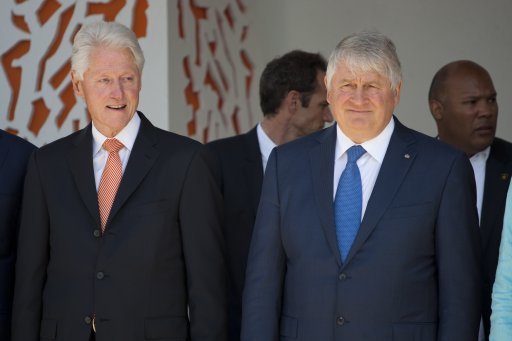
Bill Clinton and Denis O’Brien

“This attack may not be deliberate Trump payback for overt political assaults on him by senior politicians in the Dáil this year, but it should be enough to worry Irish voters,” Colum Kenny writes in The Irish Times. “With the E.U. going after tax breaks for U.S. jobs here, we do not need a pissed-off president in the White House.”

Here’s the email the Trump campaign sent to reporters, which quotes extensively from Irish and U.S. media reports.

What’s the status of Irish American Museum in Washington?

The National Museum of African American History & Culture opened this weekend in Washington, D.C. It raises this question: What’s the status of the proposed Irish American Museum of Washington, D.C.?

To be sure, there is a huge difference between the two efforts: the African American Museum is part of the Smithsonian Institution and was supported at the highest levels of the U.S. government. The Irish American Museum is a private effort. It’s backers might take some inspiration from EPIC Ireland, an interactive museum dedicated to the island’s vast diaspora. I visited in July, shortly after it opened in Dublin’s dockland’s district.

Entrance of EPIC Ireland in Dublin's docklands district.

Entrance of EPIC Ireland in Dublin’s docklands district.

Former Coca-Cola CEO Neville Isdell spent some €22 million on the CHQ Centre at the heart of the city’s International Financial Services Centre, converting 1820s-era vaulted storehouses below a modern shopping center into 21 galleries with topics such as politics, arts and sport. The Irish government withdrew its own plans to support the museum, saying that no capital funding was available, according to The Irish Times.

The African American Museum tells a critical part of American history and is an important addition to the National Mall. The contributions of the Irish in America are no less important, their stories no less compelling. More than 33 million U.S. residents claim Irish heritage, the Census Bureau says.

So what’s the status of the Irish American Museum? I’ve reached out to project leaders and will report their reply. Until then, here’s my 2014 Washington Business Journal story about their effort.

Video screens inside EPIC Ireland show images of St. Patrick's Day parades around the world.

Video screens inside EPIC Ireland show images of St. Patrick’s Day parades around the world.

‘Easter, 1916’ quietly reaches its 100th anniversary

Another milestone of the 1916 Easter Rising centennial arrives 25 September. That’s the date W. B. Yeats jotted at the bottom of his draft notes for the poem “Easter, 1916.”

wbyeats.jpg (286×289)In May 1916, as 15 Irish rebels faced British firing squads, Yeats hinted at the poem’s most famous line in a letter to his Abbey Theatre co-founder Lady Gregory: “I am trying to write a poem on the men executed—’terrible beauty has been born’.”

The poem was not published until 23 October, 1920, when it appeared in the New Statesman, launched in 1913 to give voice to the unrest of the period. In 1921, “Easter, 1916” was included in Yeats’ Michael Robartes and the Dancer.

The completion date of “Easter, 1916” is unremarked in the official centennial programs of the Irish government and the National Library of Ireland. It is noted on the 1916 timeline of the Decade of Centenaries website.

Read the full poem.

Support for united Ireland not boosted by Brexit

Just over half (52 percent) of Northern Ireland voters in a new opinion survey say they do not want a referendum on political reunification of the island.

The poll for BBC Northern Ireland’s “The View” comes just shy of three months since the United Kingdom voted to leave the European Union. In the referendum, 56 percent of the Northern Ireland electorate voted to remain in the E.U.

british-irish-flags-dublin-390x285.jpg (390×285)In the wake of the Brexit referendum result, Sinn Féin demanded that the secretary of state call a border poll, as provided by the Good Friday Agreement. The government can call a border poll if it “appears likely that a majority of those voting would express a wish that Northern Ireland should cease to be part of the United Kingdom and form part of a united Ireland.”

The BBC poll shows that if such a border poll were held now, 63 percent of northern residents would vote to stay in the U.K., while just 22 percent would support joining the Republic of Ireland.

Shortly after the 23 June Brexit vote, the Department of Foreign Affairs in Dublin reported a sharp rise in the number of people from the North applying for Irish passports. Some observers quickly interpreted this as indicating support for a united Ireland.

Critics slam new film on Northern Ireland peace process

“The Journey,” a new film about the unlikely partnership between Sinn Féin’s Martin McGuinness and the late unionist firebrand Rev. Ian Paisley, has debuted to dreadful reviews.

The Hollywood Reporter says “deficiencies in script and direction render the vehicle less than road-worthy.” The movie is “best suited to a mid-evening UK television slot” and “has little hope of big-screen exposure beyond the formerly war-torn province whose history it depicts.”

“The Journey,” according to The Telegraph, is “a graceless Wikipedian plod through the Irish peace process … a tremendously promising idea squandered beyond the limits of human ken.”

Adds The Guardian: “This film feels the need to be fair, to be balanced. That is understandable. But it is tiptoeing on eggshells of its own making.”

“The Journey” debuted 7 September at the 73rd Venice International Film Festival. As yet no trailers are posted on YouTube.

Timothy Spall as Ian Paisley, left, and Colm Meaney as Martin McGuinness in "The Journey."

Timothy Spall as Ian Paisley, left, and Colm Meaney as Martin McGuinness in “The Journey.” Below, the real deal.

16/7/2007. Northern Ireland Deputy First Minister, Martin McGuinness, and First Minister, the Rev Ian Paisley, at the press conference at Parliament Buildings, Stormont (Belfast), after their meeting with British Prime Minister Gordon Brown. Pic. Albert Gonzalez/RollingNews.ie

Albert Gonzalez/RollingNews.ie


Irish tourism on record pace, including best ever July

Tourism to Ireland increased nearly 13 percent from January through July, compared to the same seven months in 2015, figures released 2 September show.

“Today’s figures indicate that this was the best ever month of July for Irish tourism, with more than 1 million arrivals recorded,” Niall Gibbons, CEO of Tourism Ireland, said in a release. The organization said it is preparing to launch an “extensive autumn campaign aimed at boosting late-season travel to Ireland.”

The announcement coincided with the release of travel data from the Republic’s Central Statistics Office, which combines the U.S. and Canada as areas of visitor residence. For May-July this year, 635,600 North Americans traveled to Ireland, compared to 561,200 the same three months of last year, and 488,100 the same period of 2014.

I very much enjoyed being part of this year’s total with my July visit.

A Dublin building bloom in July 2016. The city was very crowded with visitors, including myself.

A Dublin building blooms in July 2016. The city was crowded with visitors, including myself.