Tag Archives: Heather Humphreys

Connolly cruises as Irish voters protest

  • Update 5:

Some American press coverage of Connolly’s win:

The winner.                  Daniel Carey photo

“Ireland, in a cautionary rebuke to the governing establishment, has voted overwhelmingly to elect an outspoken leftist to the country’s mostly ceremonial presidency — a landslide victory for an independent lawmaker who has accused NATO of ‘warmongering’ and built her campaign on demands for economic justice at home and fury over the plight of Gaza abroad.” —  Washington Post, via London.

“Independent socialist Catherine Connolly swept to a landslide victory Saturday to become Ireland’s next president, dealing a record-breaking rebuke to the two center-ground parties of government. — Longtime Ireland correspondent Shawn Pogatchnik of Politico.eu, via Dublin.

“Left-wing independent Catherine Connolly, who secured the backing of Ireland’s left-leaning parties including Sinn Féin, has won the country’s presidential election in a landslide victory against her center-right rival.” —  Associated Press, via London

As of 8 a.m. Eastern, Oct. 26, the New York Times had no coverage of the election result. The Times finally reported the election results Nov. 2.

Update 4:

Catherine Connolly is officially the tenth president of Ireland. She secured 63.36 percent of the first preference tally, a total of 914,143 votes, compared to 29.46 percent for Heather Humphreys and 7.18 percent for withdrawn candidate Jim Gavin.

Nearly 214,000 voters submitted spoiled ballots, almost 13 percent. That dwarfs the slightly more than 1 percent  of spoiled ballots in the 2018 and 2011 presidential elections. The 46 percent turnout slightly exceeded the last election.

Connolly will be officially inaugurated on Nov. 11.

Update 3:

Leftwing independent TD Catherine Connolly is cruising to an overwhelming victory as Ireland’s tenth president. Heather Humphreys has conceded.

Connolly has secured roughly 64 percent share of the vote based on incomplete results, according to the Irish Times and other media. Humphreys is bumping along around 30 percent, and withdrawn candidate Jim Gavin about 7 percent.

But the biggest story of the election is that disgruntled voters, unhappy with the choices, have spoiled an unprecedented number of the ballots, currently estimated at 13 percent. (This is not included in the percentage totals above.) … Results are still being tabulated.

Connolly is cruising. These signs near the DART station in Dun Laoghaire.                                    Michael Doorley photo.

Update 2:

Polls have closed in Ireland’s tenth presidential election under the 1937 Constitution. Counting will begin Saturday morning and the winner could be declared quickly if pre-election polling, which strongly favors Connolly, is correct. Here are some key numbers to watch:

  • 1.2 percent; spoiled votes in the last presidential election in 2018. A significantly higher number this year could signal widespread disenchantment with the two candidates.
  • 12.5 percent; first-preference vote threshold for Fianna Fáil to recoup some of its election expenses for nominating Jim Gavin, who dropped out of the race but remained on the ballot. Irish elections are capped at €750,000; campaigns can claim a reimbursement of up to one third that amount.
  • 15-19 points; the margin of Connolly’s lead in three pre-election polls.
  • 44 percent; turnout in the 2018 presidential election, or just under 1.5 million voters. Early totals suggest turnout will be lower, perhaps under 40 percent.
  • 55.81 percent; outgoing President Michael D. Higgins’ first preference share in the six-person 2018 contest.
  • 822,566; Higgins’ first-preference vote total, enough for the 50 percent plus one needed to secure reelection.
  • 3.6 million; eligible voters, about 300,000 more than the November 2024 general election.

Update 1:

Voting is underway in Ireland. … Both candidates have cast their ballots: Catherine Connolly in Galway city, underdog Heather Humphreys in Monaghan. Outgoing President Michael D. Higgins has voted in Dublin. … Polls are open until 10 p.m. Irish time, or 5 p.m. US Eastern time. … The weather is cold and damp, with showers forecast in many parts of the country but periods of sun. … Election officials expect a low turnout.

Original post:

Irish voters on Friday will decide a two-woman contest for president. The candidates are leftwing independent TD Catherine Connolly, backed by Sinn Féin and Labour, and former Fine Gael minister Heather Humphreys, a center-right establishment figure. Connolly is widely expected to win, based on polling and debate performances. But Irish voters have surprised political pundits in the past.

Ghost candidate: Gavin’s campaign signs are still posted in Dublin, and his name remains on the ballot. Daniel Carey photo.

In addition to monitoring Irish media coverage, I’ve reached out to family members in Kerry and Meath, as well as several Irish historian friends in Dublin to help assess the election. Some of their comments are attributed, others are kept anonymous on request.

In general, the Irish electorate is grumpy and dissatisfied with the binary choice. “Unenthused” is the word one of my correspondents used. “Resignation” was another. Historian and former public servant Felix M. Larkin wrote:

“My very personal take on the election is that we have been badly served by the establishment parties. The long-mooted Fine Gael candidate had to pull out because of health issues and, like Kamala Harris, Humphreys was parachuted in at the eleventh hour and was manifestly unprepared for the campaign. Fianna Fáil opted for a ‘celebrity’ candidate who was totally unqualified for the job and whose campaign imploded when past shenanigans as a landlord embarrassingly came to light.”

The “celebrity” candidate was Jim Gavin, the former GAA coach whose campaign was sidelined by the revelation that he failed to refund €3,300 in back rent to a former tenant. The tenant turned out to be a Sunday World journalist. Gavin withdrew from the race on Oct. 6, but his name remains on the ballot.

At least Ireland has been spared the spectacle of having far-right mixed martial arts fighter Conor McGregor in the race. He almost makes Donald Trump look like a choir boy.

Several of my correspondents said they will reluctantly vote for Humphreys, thus the possibility of a surprise outcome (HH instead of CC) mentioned at the top of this post. One of my relations is considering spoiling her ballot in protest.

Larkin said Sinn Féin and Ireland’s “responsible left parties” (Labour and the Social Democrats) seemed to back Connolly based on a strategy “to chase the chimera of a ‘United Left’ coalition for the next General Election. Did they ever think Connolly could win?  I doubt it, but the unimaginable appears to be about to happen.”

On press reports of Ireland’s ‘first’ president, 1938

(My next post will be the eve of the election, Oct. 23, with updates through election day until the winner is announced, probably Oct. 25 or 26. MH)

Irish voters on Oct. 24 will elect the country’s tenth president under the constitution their ancestors adopted in 1937. Irish language scholar Douglas Hyde was nominated as the first president in 1938 by the country’s two main political parties, avoiding a contested election.

“Not a word of English was spoken at the inauguration of the Protestant as the head of the Catholic state,” the Associated Press reported to American newspaper readers. Americans in several markets such as New York/New Jersey, Massachusetts, and Washington, D.C. also were able to listen to a radio broadcast of the Irish language inaugural from Dublin.[1]”Dr. Hyde Inducted As Irish President”, Philadelphia Inquirer, June 28, 1938, and other papers. Radio program listings in multiple papers.

Statue of Douglas Hyde in Co. Roscommon.

Nine of every 10 Irish citizens in 1938 were Catholic, and many aspects of the country’s political and social life were certainly influenced by the Church. But the new constitution that began to transform the 26 counties of southern Ireland from the Irish Free State, created in 1922 as a dominion of the United Kingdom, “did not declare Catholicism the state religion, to the disappointment of my zealous Catholics.” The 1937 constitution also did not declare an Irish republic, though the document defined the state as having 32 counties.[2]Diarmaid Ferriter, The Transformation of Ireland. [New York: Overlook Press, 2005], 369-70.

Some American news analysts framed Hyde’s selection as an olive branch to the six partitioned counties of North Ireland, which was roughly two thirds Protestant at the time.[3]In 1937, 30.5 % Presbyterian; 27% Church of Ireland; 4.7% Methodist. “Breakdown of population in Northern Ireland according to Religion, 1861-1991” at CAIN Archive. Catholics now outnumber … Continue reading But Hyde’s ascendance to the new figure head position of president did not reassure northern hardliners. The Ulster Unionist Party of Sir James Craig solidified its hold on power in the north during an election earlier in 1938. The Anglo-Irish Trade Agreement of that year, which ended a five-year dispute over tariffs and transferred control of several naval ports from Britain to Ireland, further reinforced northern recalcitrance.

Hyde’s religious affiliation was not the only thing that made him an unconventional choice. “Politicians usually want a practical man as the head of the state, but Dr. Hyde is a poet,” observed Milton Bronner of the Newspaper Enterprise Association. “The dominant cry in Europe is for young men as leaders, but the Irish chose Dr. Hyde, who is 78.”[4]”Aged Poet, ‘Enemy of None,’ To Be President of Ireland”, Pittsburgh Press, June 5, 1938, and other papers. For more on Bronner, see my post: “Could Maine potatoes have … Continue reading

Bronner’s analysis and other American press reports about Hyde’s inauguration noted his 1906-07 tour of the United States to raise money and awareness for the Gaelic League. These same stories mention that Eamon de Valera, as taoiseach, or prime minister, continued to hold the real political power in southern Ireland. But I have not found any American coverage that recounted de Valera’s 1919-20 U.S. tour as “president of the Irish republic.”

De Valera in 1937.

No such position or country formally existed at the time. De Valera’s real title was Príomh Aire, the chief minister or president of Dáil Éireann; the separatist parliament established in January 1919 by Sinn Féin candidates who won Irish constituencies in the December 1918 British general election. The title of president of Ireland was bestowed on de Valera by Irish American supporters to more easily convey his leadership position to American audiences.

In 1938, at least one letter to the editor writer in Ireland questioned the new title of Irish president, even if the American press missed the historical irony. The Dublin writer noted not only that de Valera had declared himself president in 1919, but also that Pádraic Pearse made the same claim at the 1916 Easter Rising. “Apparently we are now expected to forget that the Irish republic ever existed, or that the blood of Ireland’s greatest men was shed in its defense, and to regard the history of Ireland as commencing on the date of the enactment of de Valera’s new constitution.”[5]”President of Ireland” in “Our Readers’ Views On Topics Of The Day”, Irish Independent, June 27, 1938.

Afterward:

  • Full republic status came to the 26 counties of southern Ireland in 1949. The 1937 constitution’s claim on a 32-county state was amended in 1998 as part of the Good Friday Agreement.
  • De Valera transitioned from taoiseach to president in 1959. He held the latter position until 1973.
  • The Irish Times has ranked Hyde as second best among the nine presidents of Ireland, with de Valera placed at seventh. See their list.

The two candidates vying for the Irish presidency later this month are Catherine Connolly, who was raised Catholic but describers herself as areligious, and Heather Humphreys, a Presbyterian by religious affiliation who describes her politics as moderate Irish republicanism rather than Protestant unionism. Connolly is a fluent Irish speaker, while Humphrey struggles with the language. As mentioned in the previous post, whoever wins the election will become Ireland’s third woman president.

References

References
1 ”Dr. Hyde Inducted As Irish President”, Philadelphia Inquirer, June 28, 1938, and other papers. Radio program listings in multiple papers.
2 Diarmaid Ferriter, The Transformation of Ireland. [New York: Overlook Press, 2005], 369-70.
3 In 1937, 30.5 % Presbyterian; 27% Church of Ireland; 4.7% Methodist. “Breakdown of population in Northern Ireland according to Religion, 1861-1991” at CAIN Archive. Catholics now outnumber Protestants in Northern Ireland by 45.7% to 43.5%.
4 ”Aged Poet, ‘Enemy of None,’ To Be President of Ireland”, Pittsburgh Press, June 5, 1938, and other papers. For more on Bronner, see my post: “Could Maine potatoes have relieved Irish hunger in 1925?
5 ”President of Ireland” in “Our Readers’ Views On Topics Of The Day”, Irish Independent, June 27, 1938.

Gavin’s withdrawal upends Irish presidential race

UPDATE:

It’s legally too late to remove Gavin from the ballot. This means any votes cast for Gavin will still need to be counted and redistributed to the other two candidates under Ireland’s proportional representation with a single transferrable vote system. This could prove pivotal in deciding the winner.

“There’s even a fear in government circles that disillusioned voters angry with the choices on offer could vote for Gavin in protest, ‘electing’ a figure who’s no longer willing to serve as Ireland’s next ceremonial head of state,” reported Shawn Pogatchnik at Politic.eu. “That would produce a potential constitutional crisis.”

ORIGINAL POST:

Ireland will elect its third women head of state on Oct. 24 following the surprise withdrawal of Fianna Fáil candidate Jim Gavin.

The race is now a head-to-head contest between independent TD (Teachta Dála, or member of the Dáil Éireann, similar to member of the U.S. House of Representatives) Catherine Connolly, 68, and former Fine Gael TD and government minister Heather Humphreys, 62. Connolly is on the political left, and supported by the Irish Labour (she is a former member) and Sinn Féin parties. Humphreys is a more center-right, establishment figure.

Gavin’s Oct. 5 departure announcement shocked the Irish electorate. In the few weeks since his nomination, the Irish Aviation Authority senior executive and former Dublin GAA football manager was revealed as an uneven and inexperienced campaigner. His credibility cratered over recent questions about owing back rent to a former tenant. That’s hardly a position of strength in a country with an ongoing housing crisis and a history of testy (sometimes violent) landlord-tenant relations.

Gavin was the personal selection of Irish Taoiseach (Prime Minister) Micheál Martin, who now will face questions about, and challenges to, his leadership of the Fianna Fáil party and the country.  Martin’s political chops are certainly much stronger than Gavin’s, so he might outlast this controversary, as he has others in the past.

Mary Robinson (1990-1997) and Mary McAleese (1997-2011; unopposed in 2004.) held the office of president for 21 years, followed by the two, seven-year terms of the departing Michael D. Higgins. The office is Ireland’s only national election except for occasional constitutional referendum questions.

Áras an Uachtaráin, the Irish President’s House in Dublin. It was formerly known as the Viceregal Lodge, the home of the British Lord Lieutenant of Ireland.

Irish presidential race set for Oct. 24 election

Candidate qualification has closed and the sprint to Ireland’s October 24 presidential election has begun. The field of three contenders includes:

  • Heather Humphreys, a former Fine Gael minister;
  • Jim Gavin, senior executive of Irish Aviation Authority and a former Dublin GAA football manager, was put forward by Fianna Fáil; and
  • Independent TD Catherine Connolly, backed by the Labour party she once belong to.

The winner will succeed poet and historian Michael D. Higgins, 84. He is prohibited from reelection after serving two seven-year terms. Higgins earlier this month suggested that Israel and countries that supply it with weapons (USA) should be prohibited from the United Nations.

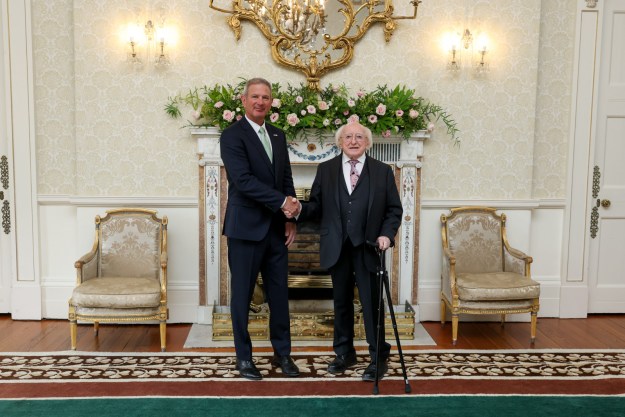
Edward S. Walsh, left, assumed the office of U.S. Ambassador to Ireland in July after presenting his credentials to President of Ireland Michael D Higgins .

This is Ireland’s only election for national office, though voters do decide national referendum questions. The taoiseach, or prime minister, is nominated by members of Dáil Éireann, who are elected from constituencies across the 26 counties. The Irish president officially appointments the taoiseach, currently Micheál Martin of Fianna Fáil.

The president’s duties also include the appointment of judges and other officials; summoning and dissolving the Dáil, and signing legislation into law and/or referring Bills to the Supreme Court for review.

Perhaps most importantly, the president serves as the people’s representative and spokesperson, a super ambassador to the world. “If the Republic still has a soul, it hovers somewhere around the president,” Irish Times columnist Fintan O’Toole wrote. That’s why Higgins’s comments about the Israel/Palestine conflict have been so important, along with his leadership through Ireland’s the “Decade of Centenaries.”

It’s a shame O’Toole had to qualify “if” Ireland still has a soul, but that’s another matter. I’ll follow the campaign in future posts over the coming month.