Category Archives: Religion

Going to Ireland? Some tips and links

I just returned from two wonderful weeks in Ireland and Northern Ireland. Several family members, friends and other social media contacts have expressed an interest in traveling there, or already have plans to visit. I know that not everyone shares my interest in Irish history, but here are some notes and links from my trip to incorporate into your own itinerary, as you see fit. Enjoy!

DUBLIN

  • The National Archives of Ireland and National Library of Ireland have excellent resources, online and onsite. You’ll have to get an easy-to-obtain readers ticket in each place to view material in person. You’ll want to visit the library’s impressive main reading room, whether you are doing research or not.
  • This year is the 100th anniversary of the 1916 Easter Rising. The effort to break from Britain failed at the time, but inspired the successful war of independence (which also created partition) a few years later. No visit to Dublin is complete without stopping at the General Post Office, or GPO, the epicenter of the 1916 revolt. The 1818 building, where you still buy stamps and conduct other business, now also offers an “immersive exhibition and visitor attraction.”
  • Some of the most important people in Irish history are buried at Glasnevin Cemetery, which offers walking tours and also has a fine permanent exhibit. Highly recommended. Photos from my earlier post.
  • EPIC Ireland, which opened in May, bills itself as “Dublin’s dramatic new interactive visitor experience that showcases the unique global journey of the Irish people.” It’s located in old shipping storehouses next to the River Liffey. A modern mall filled with restaurants and shops shares space in the chq Building.
  • See the famous Book of Kells and tour Trinity College Dublin.
  • Ireland has a strong theater tradition. I saw “The Wake” at the Abbey Theatre. IrishTheatre.ie lists venues and shows on both sides of the border.
The GPO in Dublin.

The GPO in Dublin.

BELFAST

  • Titanic Belfast. Would you visit Washington without going to the Smithsonian? Paris without a stop at the Louvre? Titanic Belfast is a modern museum experience (it inspired EPIC Ireland) about the ill-fated liner and the city that built it in the early 20th century.
  • Several companies offer “black taxi tours” of West Belfast, a once dangerous “no go” zone during the worst violence of the Troubles. The area remains divided into Catholic and Protestant neighborhoods, but is safe for these daytime guided tours, which help the local economy. Just don’t shout “God Bless the Pope” in the loyalist Shankill Road, or “God Bless King Billy” in the nationalist Falls Road. Photos from my earlier post.
  • Take a free tour of the stunning Belfast City Hall, at the city center.
  • Visit the campus of Queens University and enjoy shops and restaurants of the surrounding neighborhood.
View of the former Harland & Wolff dry docks where the "Titanic' was built and launched in 1912 from inside the Titanic Belfast museum.

View of the former Harland & Wolff dry docks where the “Titanic’ was built and launched in 1912 from inside the Titanic Belfast museum.

THE “KINGDOM OF KERRY” & WEST OF IRELAND

  • There are many things to see and do on the rugged west side of the island, “the back of beyond.” Consider driving some (or all) of the Wild Atlantic Way, a 1,600-mile coastal route stretching between Cork in the south and Derry in Northern Ireland.
  • Shameless promotion here for County Kerry, home of my maternal grandmother and grandfather.
View of the coast at County Kerry from along the "Wild Atlantic Way."

View of the coast at County Kerry from along the “Wild Atlantic Way.”

Here are a few other tips and suggestions:

  • Major U.S. voice and data providers offer service for the island of Ireland. My iPhone switched to an Irish carrier before I reached my baggage at the Dublin airport; clicked to a U.K. telecom while on the train to Belfast; then back to the Republic provider on my return to the 26 counties.
  • Data service in the West of Ireland is spotty, so be prepared to use a paper map and ask for directions rather then relying on Google Maps. Besides, you’re in Ireland! Do you really want to be looking at your screen all the time?
  • That said, don’t forget to bring a power adapter/converter to recharge your phone and other electronics. Outlets are different than in the U.S.
  • Be prepared to drive from the right side of the vehicle on the left side of the road. Just remember that as the driver you should be toward the center of the road, passenger on the outside, same as in the U.S. You will pay a premium to drive a car rented in the Republic in Northern Ireland.
  • Transit and taxi service is excellent in Dublin and Belfast. You don’t need a car in either city. You will if you want to explore the rest of the country.
  • Let your bank and credit card company know that you’re traveling overseas. Grab hard currency from an ATM as needed. Easy!

Mass at St. Patrick’s Church, Belfast

BELFAST~Given the long history of sectarian strife in Belfast, the opportunity to practice my faith here felt infused with extra meaning and significance, especially at a church named after Ireland’s patron saint. I’ve visited more than a dozen St. Patricks’ churches over the years.

Less then two weeks ago, Protestant loyalist bands marched past the church playing triumphalist tunes and otherwise intimidating Catholics, breaching Parades Commission protocol for 12 July. The regular 1 p.m. weekday Mass was cancelled. It wasn’t the first time this has happened.

St. Patrick’s at 199 Donegall St. opened in 1815, same year as the Battle of Waterloo and before Catholic Emancipation in Ireland. The church’s centennial was the second year of the First World War; its bicentennial just last year. More history here.

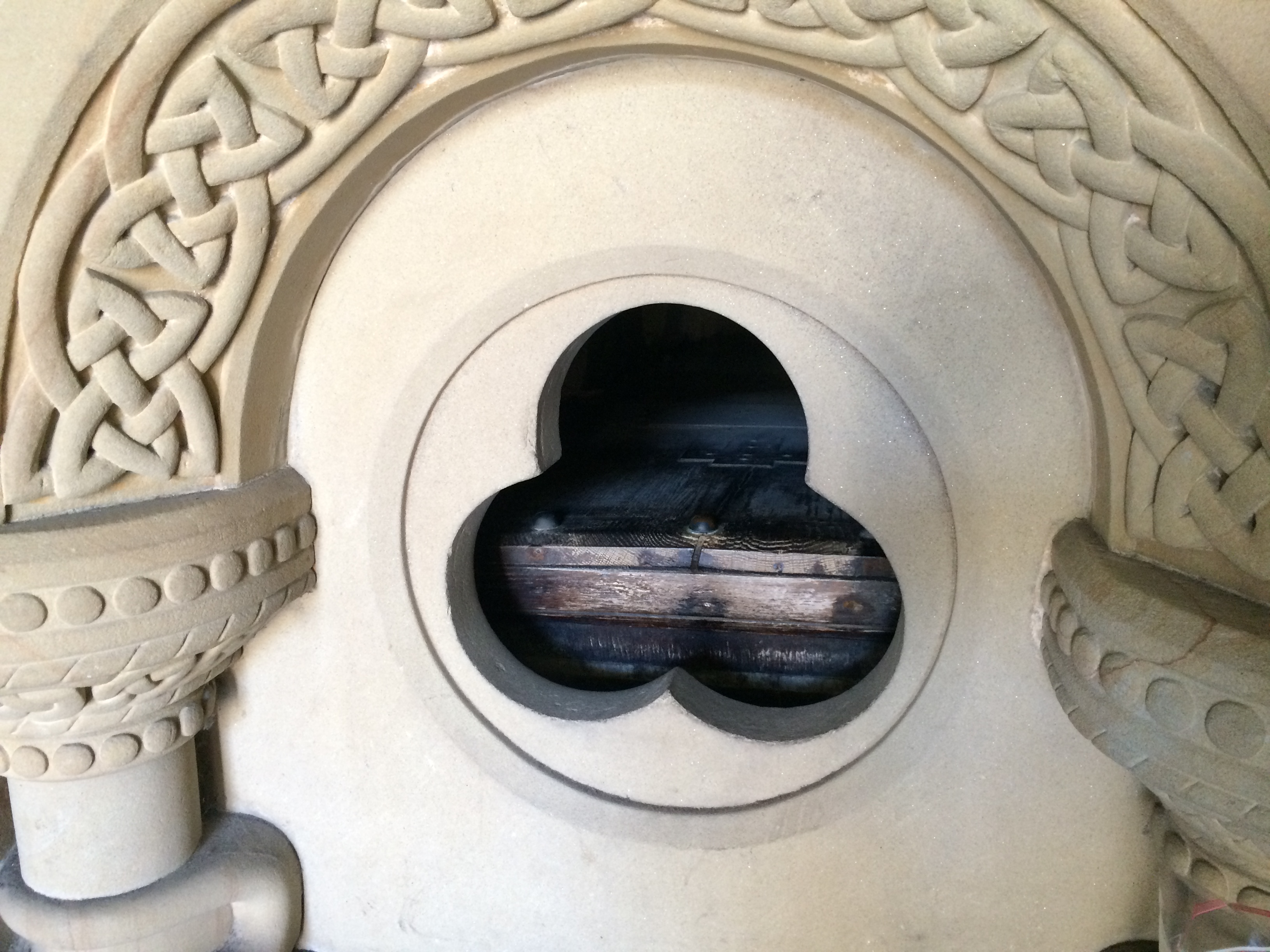
Today, the exterior sandstone of the Romanesque style church is under significant restoration, including original stone carvings by James Pearse, father of Patrick Pearse, a leader of the 1916 Easter Rising.

I enjoyed the 1 p.m. weekday Mass and contributed to the restoration.

File_000 (16)File_000 (17)

Visiting Glasnevin, part 1: Daniel O’Connell

DUBLIN~Here’s an amazing fact about Glasnevin Cemetery: the more than 1.5 million people interred on its 124 acres outnumber residents of the surrounding capital city. Some 800,000 of the dead are buried in unmarked graves, but their names are recorded in an extensive archive.

Kerryman Daniel O’Connell, best know as “The Liberator” for bringing Catholic emancipation to Ireland, established the Dublin Cemeteries, which opened the originally nine-acre site in 1932. Then, as today, Glasnevin is open to people of all faiths, or no religion at all.

O’Connell is honored with the most conspicuous grave at the cemetery: a large crypt underneath a 168-foot tower. Visitors can reach underneath the marble slab and pat the lead-lined oak casket … for good luck, or just to touch history. File_000 (8)File_000 (2)

File_000 (4)

The rough road to Dublin, 1932

The Irish Story has published an excellent piece by Barry Sheppard exploring how the 1932 Eucharistic Congress in Dublin “inflamed sectarian passions” in Northern Ireland.

Held once every four years, an International Eucharistic Congress is a gathering of Roman Catholic clergy, religious and laity for the purpose of bearing witness to the “Real Presence of Jesus” in the Eucharist, one of the church’s core beliefs. The 31st such Congress, 22–26 June 1932, arrived 10 years after the partition of Ireland and three years after the 1929 centennial of Catholic Emancipation. Sheppard quotes another author who described the later event as “the public identification of the new state with an apparently unified and triumphant Catholicism.”

Sheppard continues that contemporary newspaper representations of the Congress portrayed it as the apex of Irish history, or the high point of Irish religious history. Such “triumphalist reporting no doubt had negative connotations among the Protestant unionist population in Northern Ireland.”

The result were a series of bloody clashes in the north, and a hardening of the island’s already bitter sectarian divide. As I read the story, several questions immediately came to my mind:

  • What did English Catholic author C. K. Chesterton have to say about this?

I pulled my copy of “Christendom in Dublin” from the shelf. Chesterton doesn’t mention the violence in the north in his 1933 book about the Congress. He does open with a chapter titled “The Flutter of the Flags,” a breezy discourse on the Union Jack, the tricolour of the then Irish Free State and the Papal flag. “It must be remembered that, to the Dublin populace, the Union Jack is not so much the popular flag of the English people; it is the party flag of one Irish party; the old Orange party of Ascendancy.”

Later, Chesterton writes that seeing so much of Christendom in Dublin was like being taken to the top of a mountain and seeing all the kingdoms of the earth. He adds: “If any bright wit from Portadown or Belfast retorts that the Devil, in the person of the Papal Legate, would naturally take me there, I am content to bow and smile.”

  • What did the American press have to say about this?

This four-deck headline on page 2 of  the 27 June edition of The New York Times reflects the international coverage:

Catholics Mobbed in Belfast Region

Crowds Stone Pilgrims Boarding Trains for Eucharistic Congress in Dublin
Rioters Knock Girls Down
Tear Hats, Lunch Baskets and Umbrellas From Women–Buses and Steamers Attacked
  • What does history have to say about this?

In his 2009 book, “The Eucharistic Congress, Dublin 1932”, author Rory O’Dwyer observes that charges the event only served to further consolidate the partition of Ireland are undeniable. Still, Ireland’s religious and political divisions were already “firmly entrenched” by this time. Then, he slyly notes:

Two weeks (after the Congress), main streets in most Northern towns were profusely decorated with loyalist symbols of the Twelfth of July celebrations. There was no record of any damage to these decorations.

Midsummer “marching season” violence between Catholics and Protestants did occur long before the 1932 Congress, and some of the worst such rioting happened just three years later. That’s detailed in another piece in The Irish Story by John Dorney.

JFK’s birth cenntennial: Between Duganstown and Dallas

Daniel Donoghue and Father William O’Keeffe witnessed the triumph of Duganstown; but they each died before the tragedy of Dallas.

The 99th anniversary of the birth of John Fitzgerald Kennedy (29 May 2016) begins a countdown to next year’s centennial celebration. Fishamble, an Irish theater company, recently debuted six “tiny plays” inspired by Kennedy’s life at the Washington, D.C. performing arts center named in his honor, part of a year-long series of tributes. More remembrances will surely be scheduled in other places, including Boston and in Ireland.

Born in Brookline, Massachusetts, the 35th president of the United States was the youngest man (43) and first Irish Catholic elected to the nation’s highest office. There are many aspects of Kennedy’s life worth exploring, but I’ve become interested in his last five months, the period from his triumphant “homecoming” to Ireland, 26-29 June 1963, the first visit by a U.S. president while in office, to his assassination in Dallas on 22 November 1963.

President John F. Kennedy, left, speaks at welcoming ceremony in Duganstown, New Ross, Ireland. Image from JFK Presidential Library & Museum.

Kennedy described the 1963 visit as “the best four days of my life.” It wasn’t his first trip to Ireland, but it was the most historic and symbolic, including his address to the Dail, and return to his ancestral homestead at Dunganstown, New Ross, County Wexford. Four months later, 15 October 1963, Kennedy welcomed Irish Taoiseach Sean Lemass to the White House. The host told his guest that in several days of traveling in America he would see “more Irish men and Irish woman who were either born in Ireland or bear Irish blood than you would see in several years in Ireland.”

I was intrigued by the interval between Kennedy’s visit and his death, so I went looking for Irish and Irish Americans who died between 30 June 1963 (after his trip) and 21 November 1963 (before his assassination.) It is a somewhat arbitrary way of selecting a cohort. Yet the magnitude of the two events, I believe, makes for interesting parameters to explore Kennedy, the Irish and Irish America. They are not “Kennedy’s Children,” but rather his big brothers and sisters, his cousins and colleagues. The first two people I found were Daniel Donoghue and Fr. William O’Keeffe.

Donoghue, a retired Metropolitan (Washington) Police lieutenant, was typical of the people Kennedy was referring to in his greeting to Lemass, though he had recently departed from their ranks, dead of a heart attack at 65 on 18 September 1963. The County Kerry native immigrated to America in 1915, when he was 17, according to an obituary in The Washington Post. He served on the police force until 1953, then moved to the Maryland suburbs, where he remained active in the Retired Metropolitan Police Association. In the 1920s, Donoghue was a charter member of St. Gabriel’s Catholic Church in D.C.’s Petworth neighborhood. He belonged to the Holy Name Society.

Donoghue was a likely Kennedy voter in 1960 and certainly had paid close attention to the president’s visit to Ireland. It is unclear whether the former cop ever got himself back to Ireland. He left a year before the Rising, but was old enough to have followed Ireland’s struggle for independence, bloody civil war and partition as he established his life in America. He also would have lived through the humiliating defeat of Al Smith, the first Irish-Catholic presidential candidate, in 1928. 

To me, Donoghue is part of a “greatest generation” of Irish and Irish Americans who lived through the country’s revolutionary period and transformation from Irish Free State to Republic of Ireland. In America, their adult lives spanned from Smith’s defeat to Kennedy’s election and trip to Ireland. They died before the tragedy in Dallas and outbreak of The Troubles.

As Irish Catholics, this generation witnessed the peak ascendance of their church and its schools, hospitals and other institutions in America and their own acceptance as adherents of the faith by nearly all aspects of U.S. society. They died before the changes of Vatican II, the decline of European ethnic-religious identity and the revelations of church scandals on both sides of the Atlantic.

Father O’Keeffe was another member of this cohort. Spiritual director at Clonliffe College in Dublin, he died 27 August 1963, at age 56, during an extended visit to America.

He was born in 1907 at Kanturk, County Cork, and ordained in 1932 from Maynooth College, a member of the Vincentian Fathers. He was a language expert who taught in Belgium and Italy, as well as in Ireland. His skills brought the attention of the British Government during World War II, according to his obituary in the Post.

“Working under complete secrecy, he spent the war years broadcasting coded messages to the anti-Nazi underground in occupied France, Denmark and the Low Countries,” the Post said. “It was reported that he had been in occupied Europe on missions with the various undergrounds.”

Fr. O’Keeffe “was visiting childhood friends” in Glen Cove, New York, on Long Island, when he was struck down by a cerebral hemorrhage, the obit said. Surely they had talked about Kennedy’s visit to Ireland earlier that summer, and may have heard about plans for Lemass’ trip to America.

I intend to pursue more such stories over the coming year and would welcome the input of my readers. The lives of people with direct connections to JFK would make for even better stories, but that’s not a requirement. Let me hear from you.

One hundred years…and counting

Sunday, 24 April marked the “calendar centenary” of the start of the 1916 Easter Rising, though commemorations of the historical event have been on for more than a month. Sunday also was Census Day in Ireland.

Marking the 100th anniversary of the 1916 Easter Rising on 24 April 2016...Census Day in Ireland. Photo courtesy of Sr. Cathy Cahill.

Crowds outside the General Post Office in Dublin commemorate the 100th anniversary of the 1916 Easter Rising. 24 April 2016 also was Census Day in Ireland. Photo courtesy of Sr. Cathy Cahill.

The Irish Independent reports:

[F]amilies and individuals all over the country will fill out their census forms. Many will ponder whether they still consider themselves Catholic, and whether they should claim to be able to speak Irish – even if they can only say “slán” and “go raibh maith agat“. …

Despite the recession exodus, the population is still expected to show a five-year increase … to more than 4.6 million. … With a continuing high birth rate also making up for emigration losses, the population increase is now running at 25,000 per year. …

[The] census is likely to show a more cosmopolitan population with a diverse mix of nationalities and creeds. Ireland’s Islamic population has grown tenfold in two decades to more than 50,000 and this trend is likely to be confirmed. At the last census, 3.8 million people still classified themselves as Catholic, but some commentators believe the census should ask how often they attend Mass. …

Even 10 years ago, the possibility of same-sex marriage in Ireland seemed unthinkable, but it has been legalized by a popular vote, against the wishes of the Catholic hierarchy.

A census has been conducted in Ireland since 1821, though original documentation from many of those early surveys has been destroyed by accident or on purpose. The most popular and intact surviving censuses are the household returns and ancillary records for 1901 and 1911. The State has taken a count every five years since 1951.

The Central Statistics Office says it will release the first results of the 2016 Census to the public in July.

The Irish people commemorated the 1916 Rising on 24 April, then went home and completed their census forms. Photo courtesy of Sr. Cathy Cahill.

The Irish people commemorated the 1916 Rising on 24 April, then went home and completed their census forms. Photo courtesy of Sr. Cathy Cahill.

Best of the Blog, 2015

This is my third annual “Best of the Blog” (BOB, as my wife calls it), a look at some of the most important news stories, historical anniversaries and personal favorite posts of the past year. The items are not numbered, so as to avoid the appearance of rank. Most links are to my own posts, but a few are to outside websites.

Enjoy. Thanks for supporting the blog. And Happy New Year!

  • Four years into the “Decade of Centenaries,” 2015 proved that even as Ireland remembers its past, Ireland is not bound by its past. This was most dramatically demonstrated in May as Irish voters enshrined same-sex marriage rights in the Republic’s constitution, becoming the world’s first nation to give such approval through popular referendum. The outcome prompted Catholic Archbishop Diarmuid Martin of Dublin to comment: “The Church needs a reality check right across the board, to look at the things we are doing well and look at the areas where we need to say, have we drifted away completely from young people?”
  • Other long-standing Irish institutions also changed in 2015. Clerys, a landmark department store on O’Connell Street in Dublin, closed in June after 162 years in business. … In August, Aer Lingus was acquired by British Airways owner IAG for €1.5 billion after nearly 80 years of state ownership.
  • The erosion of the Irish language continued at “a faster rate than was predicted” by a 2007 study and “demands urgent intervention,” a government agency reported in an update this year.
  • 2015 was the 150th anniversary of the birth of William Butler Yeats. His poem, “The Lake Isle of Innisfree,” was celebrated during the year. And, of course, “Easter, 1916.”
  • The Republic’s official remembrance of the Easter Rising began in August with a commemorative re-enactment of the funeral of Jeremiah O’Donovan Rossa. The original Dublin funeral of the Fenian leader, who died in New York, set the stage for the Rising eight months later. Pádraic Pearse’s oration at Rossa’ graveside became a call to arms that continues to inspire Irish patriots. One of my Kerry relatives kept a copy of an August 1933 reprint of the speech, cut from the pages of The Gaelic American.
  • I also reflected on my copy of a 1953 St. Patrick’s Day greeting from another Kerry relation.
  • In Northern Ireland, the International Fund for Ireland launched a new “Community Consolidation-Peace Consolidation” strategy for 2016-2020 focused on removing some of the more than 100 “peace walls” that separate Catholic and Protestant communities. “We have a role to take risks that governments can’t take,” IFI Chairman Dr. Adrian Johnston said during a September briefing at the Embassy of Ireland in Washington, D.C. … But a new poll showed that support for removing the physical barriers has dropped to 49 percent, compared to 58 percent in 2012.
  • The British and Irish governments announced a new political accord to overcome various crises in the North. … Seventeen years on from the historic 1998 Good Friday Agreement, former U.S. Senator George Mitchell told a Washington audience the peace talks got off to “a very rocky start” due to the long history of mistrust in Northern Ireland and “no habit of listening to the other side.”
  • An RTÉ/BBC poll revealed two-thirds of respondents living in the Republic favor political reunification of the island within their lifetime, while just under one third of those surveyed in the North share the view. … In what was described as a “rogue action,” the Republic’s tricolour flag flew over Stormont for a few hours in June.
  • Irish Minister for Diaspora Affairs Jimmy Deenihan, speaking at the  Embassy of Ireland in Washington, announced “a new strategy to improve Ireland’s connection with the diaspora.”
  • More historical records continued to be made available in 2015 for online inspection, including:

Dublin Metropolitan Police Detective Department’s “Movement of Extremists” reports leading up to the Rising, held at the Irish National Archives;

Long-awaited Catholic parish records, held by the National Library of Ireland; and

Fenian Brotherhood records and O’Donovan Rossa’s personal papers, held by The Catholic University of America in Washington, D.C.

River Shannon by Therea M. Quirk.

Departed in 2015:

  • Six college students, five from Ireland and one holding Irish and U.S. citizenship, were killed 16 June in Berkeley, California, when the fifth floor apartment balcony where they were partying collapsed and plunged them 50 feet to the ground.
  • Dublin-born actress Maureen O’Hara, who co-stared with John Wayne in the 1952 screen hit, “The Quiet Man,” died at 95. … More than three dozen other notable Irish and Irish American deaths from the arts, sports and politics are listed here.

From the Archive:

How a 19th century anti-Irish Catholic voting law helped unseat modern Bangladeshi Muslim mayor near London

Earlier this year an English judge used an obscure section of 19th century election law to unseat the mayor of Tower Hamlets, a borough of London.

The Guardian tells how the term “undue spiritual influence” was passed down from the 1880s, when it was intended “specifically to constrain the influence of the Roman Catholic clergy on what the English establishment took to be the ignorant and impressionable minds of the Irish proletariat,” according to the story.

There’s great background here on the 1872-1892 period in Ireland.

In April, a modern judge was “entirely unashamed to use a law that was developed to subdue Irish Roman Catholics and then apply it to a contemporary religious minority that is suffering from a very similar brew of racism and hostility to what is seen as their foreign religious practises, i.e. Islam.”

Read the story.

Ireland debates abortion ahead of 2016 election

Al Jazeera America has published a well-reported, two-part series about the growing abortion debate in Ireland.

Once the ultimate taboo, all but banished from newspapers and polite discussion, abortion is becoming an increasingly ubiquitous talking point in Ireland. … As Ireland prepares for its next general election in early 2016, the question of abortion rights is shaping up as a major fight in a year that has already seen seismic social change since the legal acceptance of same-sex marriage in May.

Read Part 1  /  Read Part 2

Ireland will host Catholic world family meeting in 2018

Dublin will host the next World Meeting of Families in 2018.

The announcement came as Pope Francis wrapped up this year’s gathering in Philadelphia, concluding a historic nine-day trip to Cuba and the U.S. It’s too soon to say whether the pontiff, who turns 79 in December, will go to Ireland.

Held every three years and sponsored by the Holy See’s Pontifical Council for the Family, the event is described as “the world’s largest Catholic gathering of families.”

The Irish Catholic church as been rocked over the last decade by clergy sex abuse and Magdalene laundry scandals. A gay marriage referendum won overwhelming approval in May, and there is talk of liberalizing the country’s abortion laws, both against the wishes of the church.

Archbishop of Armagh Eamon Martin welcomed the announcement that the WMF would take place in Ireland. “Despite many challenges, the family remains at the heart of faith and of so much that we hold important in this country,” he  told The Irish Times.

Ireland hosted the 50th International Eucharistic Congress in 2012. Pope John Paul II was the last pontiff to visit Ireland, in September 1979.