Trump to visit Ireland in November

UPDATE:

It appears as of 11 September that the visit is being scratch. There is confusion and conflicting statements from the White House and media sources.

UPDATE:

Protesters say a giant “Trump Baby” blimp will fly over Ireland during the U.S. president’s November visit.  … Of more than 2,500 people taking Irish Central’s online poll, 71 percent said Trump “shouldn’t visit” Ireland.

ORIGINAL POST:

Not two weeks since Pope Francis left Ireland, it has emerged that U.S. President Donald Trump will visit the country in November. The timing will be either just before or right after Trump attends a Paris event marking the centenary of the armistice ending World War I.

Trump will visit his golf course in Doonbeg, County Clare, and Dublin, according to press reports. His itinerary also will have to accommodate the scheduled 11 November inauguration of the Irish President, as well as a planned Irish commemoration of the 1918 peace.

The timing is within days after U.S. elections on 6 November, when Trump could face a rebuke if Democrats take one of both chambers of Congress. As it turns out, I also will be traveling in Ireland, 7-13 November, for the 2018 Newspaper and Periodical History Forum of Ireland Conference, “The Press and the Vote.”

Talk of massive protests against Trump is quickly beginning to stir, along with push back from opposition leaders in the government and members of the current Irish administration.

“Yes, we have strong disagreements with [Trump’s] policy decisions but we also have a very friendly relationship with the United States,” Tánaiste and Minister for Foreign Affairs Simon Coveney told The Irish Times.

“That doesn’t mean we won’t have direct discussions from a policy perspective. That is how mature countries interact with each other. Rather than taking approaches that are unhelpful and will damage a relationship, we will have blunt, straight and honest discussions with a friendly country.”

Obviously, this story will develop over the next 10 weeks.

U.S. President Donald Trump, left, and Irish Taoiseach Leo Varadkar at the White House during the annual St. Patrick’s Day ceremony.

Catching up with modern Ireland: August

Pope Francis’ visit dominated the news from and about Ireland in August, but there were other developments. Here’s my regular monthly roundup:

  • Northern Ireland set a new world record on 29 August for the longest peacetime period without a government, 590 days and counting, the Associated Press reported. The Catholic-Protestant power-sharing administration at Stormont collapsed in January 2017. People gathered across the North to protest that “Stormont is Dormant.”

  • The number of Irish people returning to live in the Republic of Ireland has overtaken those leaving the country for the first time since 2009. See full details from the Central Statistics Office.
  • The Drinks Industry Group of Ireland reported there are nearly 1,500 fewer pubs in the country than in 2005, a 17.1 percent decrease. Off licenses increased by 11.6 percent, and wine-only establishments increased by 3.1 percent.
  • A statue of former U.S. President Barack Obama and former First Lady Michelle Obama was unveiled at Barack Obama Plaza, a fast-food and petrol station on the outskirts of Moneygall, County Offaly.
  • Kirsten Mate Maher of Waterford was crowned the 2018 Rose of Tralee. She is the first African-Irish “Rose,” and the third mixed-race woman to win the title, according to The Irish Times.
  • Wild fires revealed a giant EIRE sign carved into the ground at Bray Head, County Wicklow. The World War II relic was created to warn Allied and Axis pilots of Ireland’s neutral status. In July, a previously undiscovered henge, or circular enclosure, close to the neolithic passage tomb Newgrange, emerged as the result of exceptionally dry weather.
  • A major fire gutted the 233-year-old Primark building in Belfast city centre. It was not immediately clear whether the remaining sandstone facade of the historic five-story building could be saved.

Flames billow from the Primark store in the Bank Buildings on Castle Street, in Belfast city centre. Image from BBC.

An Irish … American … Catholic … tragedy

It seemed fitting that the latest scandals buffeting the Catholic Church arrived during Pope Francis’ visit to Ireland. The stormy conditions surrounding the church are far worse than the rain that tamped down the expected number of Mass-goers at Dublin’s Phoenix Park.

Turnout for Francis was never going to match Pope John Paul II in 1979, much less the enthusiasm of the 1932 Eucharistic Congress in Dublin, which firmly established Ireland as the most-Catholic of nations. Now, Ireland has angrily turned its back on the church due to clergy and other institutional abuses, and the rise of secularism. We all know the litany: child rape, Magdalene laundries, and Tuam graves; plus popular referendums approving divorce, same-sex marriage, and abortion.

But it’s the explosion of negative headlines from the church in America–a report on decades of abuse by priests in Pennsylvania, and similar behavior by former Cardinal Theodore McCarrick–that have amplified the Holy See’s troubles in Ireland and around the world.

Irish and American Catholicism are deeply intertwined. Waves of Irish Catholic immigrants arrived in the United States from the mid-19th century famine into the 21st century. Until recent decades, Ireland provided hundreds (probably thousands) of priests to U.S. parishes. As members of their flock climbed the social-economic ladder, some of these immigrant, or first-generation Irish-American, clerics also became powerful bishops and cardinals. No U.S. or Irish prelate has become pope.

In 1990, the American-born McCarrick was selected as a representative of Irish immigrant families at Ellis Island. In 2006, he was succeeded as archbishop of Washington, D.C., by Cardinal Donald Wuerl, who arrived from the dioceses of Pittsburgh. Within weeks of this summer’s revelations about McCarrick, Wuerl was accused in the Pennsylvania report of failing to protect children from abusive priests, many of whom … hate to say it … have Irish surnames.

Writing in National Review, Dublin-based Ciaran Burke has this slant on the U.S. and Irish churches:

To an Irish person who grew up amid the fallout of Catholic abuse scandals, the only surprising element of the Pittsburgh (sic. He means Pennsylvania.) grand-jury report is that it could happen in the United States. In Ireland, so great was the esteem in which the Church was held that it’s easy — though no less painful — to understand how clerical abuse could run unchecked by state authorities.

This description has never been true of the United States, though, where the Constitution and individual rights are supreme. … (The) abuses detailed in the Pittsburgh [sic.] report make a mockery of a society built on God-given rights. That any citizen could suffer such abuse in silence should outrage every American.

In the wake of the Pennsylvania report, Wuerl cancelled his scheduled appearance with Pope Francis in Ireland. He asked for his name to be removed from a Catholic high school in Pittsburgh, his native city. Now, as calls grow for his resignation, the Cardinal Donald Wuerl Division 9 of the Ancient Order of Hibernians in Pittsburgh must decide whether it too will drop his name.

Later this fall, the group plans to dedicate a new outdoor statue of Ireland’s patron saint at Old St. Patrick’s Church, the oldest parish in Pittsburgh, which once ranked with New York and Boston as a hub of Irish immigrants. The ceremony is now likely to be more subdued, even secular, than it would have been just a few years ago.

I will make a donation for the new statue once the date is set. I dearly love Old St. Pat’s in my native city, and have dedicated a section of this website to other similarly named churches, which are symbols of the once unabashed, if romanticized, Irish-American-Catholic identity. Like other Catholics in America, Ireland, and around the world, I am deeply angered and hurt by the church’s sins and crimes. But not as deeply as those who personally suffered the abuse.

Statue of Ireland’s patron saint outside Old St. Patrick’s Church in Pittsburgh, 2013.

Pope Francis in Ireland, Day 2

UPDATES: 

Pope Francis has ended his historic visit to Ireland after celebrating Mass at the Phoenix Park in Dublin. “In 1979, the Pope told Ireland he loves her. In 2018, he asks her for forgiveness. The theme of forgiveness has touched every one of his events: the quiet arrival, the sombre speeches and the modesty of it all,” The Irish Times reported.

***


***

“A host of power alliances and socio-moral attitudes built up over two centuries operated to protect the lie that Ireland was a beacon of Catholic and sexual purity in an otherwise pagan world. The tragic historical irony is that the obsession with avoidance of scandal facilitated ever-greater scandal.”

ORIGINAL POST:

On his second day in Ireland, Pope Francis has again addressed clergy sex abuse, this time in a rainy talk at Knock, the Marian shrine in County Mayo.

This open wound challenges us to be firm and decisive in the pursuit of truth and justice. I beg the Lord’s forgiveness for these sins and for the scandal and betrayal felt by so many others in God’s family. I ask our Blessed Mother to intercede for the healing of the survivors and to confirm every member of our Christian family in the resolve never again to permit these situations to occur.

Francis also extended “a warm greeting to the beloved people of Northern Ireland,” according to The Irish TImes.


 ***

A former top-ranking Vatican official released a lengthily letter asserting that Pope Francis had known about the abuses of a now-disgraced American prelate, Cardinal Theodore McCarrick, years before they became public, and has called on pontiff to resign, The New York Times reports.

The archbishop’s startling accusation will not come as a complete surprise to Vatican watchers, since he is part of a conservative camp that blames liberals, like the pope, for allowing homosexuality in the church. But it further complicates Francis’ efforts to convince Irish Catholics that the church is ready to confront its legacy of concealing sexual abuse.

***

The Irish Times has a roundup of coverage from around the world. “Interestingly, much of the media coverage in the US has focused on Taoiseach Leo Varadkar’s personal life, taking his (gay) sexuality as an indication of the changes in Ireland.”

A giant mosaic unveiled in 2016 at the Basilica of Our Lady of Knock (Mayo) depicts the 1879 apparition. Photo from my February 2018 visit. My June 2017 story about the shrine.

Pope Francis in Ireland, Day 1

I’ll updated the blog throughout Pope Francis’ visit to Ireland. The most recent posts appear at the top. See full coverage from:

***

***

Here’s a round up of first-day coverage:

Beginning one of the most fraught trips in his five years as pope, Francis described the “repellent crimes” and the church’s inability to deal with them as “a source of pain and shame for the Catholic community” — remarks some Irish criticized as familiar and lacking any mention of concrete steps for reform.

From the outside, it’s easy to conclude that the entire World Meeting of Families unfolding in Dublin this week is a sideshow, since the major question of the moment concerns what Pope Francis is going to say or do on the exploding clerical sexual abuse scandals in the Church. The thing is, however, it’s not a sideshow for the real flesh-and-blood families who are here, and who need the support. … Whatever may be exploding in the media at the moment, Catholic families still have deeply personal challenges for which they look to the Church for help, whether it’s raising a special needs child or coping with the fallout of a divorce.

On Saturday, as small clusters of supporters cheered the pope on sparsely populated streets, Francis sought to build a new church with his trademark pastoral style. He joked about marital spats and shared homespun wisdom with newlyweds, encouraged homeless people at a Capuchin monastery and rallied thousands at a World Meeting of Families event in a Dublin stadium. … The pope’s own advisers have warned that the church’s future depends on its success in addressing the existential threat of the abuse crisis.

If his visit were not so bafflingly short and he had taken the time to do what he does best – spend time with people who are marginalised and suffering – he might really have made a difference. He might have revivified the sense of Christianity as a radical option for the poor as opposed to a form of institutional power. But this visit feels too much like a ceremonial procession with a pastoral purpose added in as an afterthought for that to be possible.

***

***


***

Pope Francis has arrived in Ireland, giving his first remarks about the clerical abuse scandal in the country.

The failure of ecclesiastical authorities – bishops, religious superiors, priests and others – adequately to address these repugnant crimes has rightly given rise to outrage and remains a source of pain and shame for the Catholic community. I myself share these sentiments.

But the speech is drawing criticism for lack of an apology.

Ireland preps for historic visit by pope

UPDATE: I’ll publish a new post as the visit of Pope Francis unfolds over the weekend. MH

A day before his arrival, the New York Times and Washington Post feature prominent stories about the clergy abuse problem in Ireland. In the Times‘ story, a Donegal police detective says the problem is “worse than the I.R.A.”

ORIGINAL POST:

“No God for Ireland! We have had too much God in Ireland. Away with God!”

The quote is from James Joyce’s A Portrait of the Artist as a Young Man. As Ireland prepares for the 25-26 August visit of Pope Francis, the question is whether “Catholic Church” should replace “God” in the quote, which was more or less Joyce’s intention when he published the novel in 1916.

Ireland is a very different place today than 102 years ago, and also from 1979, when Pope John Paul II became the first pontiff to visit the island. As The Guardian notes in When faith fades: can the pope still connect with a changed Ireland:

In the past four decades Ireland has embraced divorce, contraception, same-sex marriage and abortion, all once unimaginable in a country where the church and the state were in an intimate partnership. In 1979, 93 percent of the population still identified as Catholic and went to mass every week. Since then, there has been a marked downward trajectory of the proportion of the population identifying as Catholic to 78 percent at the 2016 census, while the second largest – and growing – category is people who say they have no religion, at around 10 percent.

In his The Papal Visit of 1979: Context and Legacy piece in The Irish Story, Barry Sheppard writes “the evangelical zeal of the Catholic Action movement which exploded in the 1930s still loomed-large in public life, and was in fact reinvigorated in the aftermath of the (John Paul II) visit, targeting the familiar old foes of popular entertainment and cinema as agents of the decline of Irish morals. … It is highly doubtful that next week’s visit can generate the same input.”

Crux Editor John L. Allen Jr. provides FAQs on Pope Francis in Ireland, including protests and counter-events.  A word of caution, however, to anyone who plans to follow the pontiff by car. The Marian shrine at Knock, County Mayo, is about three hours west of Dublin, not four hours to the “north,” as Allen writes. Trust me, I just made the drive in February.

Pope John Paul II during his 1979 visit to Ireland.

‘Born at Sea’ talk coming Sept. 15 in Baltimore

I’m giving a Sept. 15 presentation at the Irish Railroad Workers Museum in Baltimore about “Ireland’s Famine Children Born at Sea.” It is based on my story of the same headline in the Winter 2017/18 issue of the National Archives & Records Administration’s Prologue magazine.

The talk will including additional research that I’ve done since the story’s publication earlier this year. Register for the free event, which begins at 11 a.m. The museum is located near downtown Baltimore at 918 Lemon St., a group of five alley houses where many Irish immigrants who worked for the nearby B&O Railroad lived from the mid-19th century.

Here’s my earlier post about the museum, which is worth visiting anytime.

The Irish Railroad Workers Museum and Shrine at 918 Lemon St. in Baltimore.

A modern reference to a 130-year-old Kerry murder

Earlier this year, flying home to Washington, D.C., from Dublin, I opened Fergal Keane’s Wounds: a memoir of war and love, about the struggles of life and death in North Kerry, primarily in the 19th and early 20th century.

Somewhere over the Atlantic, and on page 74 of the book, I was gobsmacked to read a short passage about the summer 1888 murder of John Foran, a Kerry farmer shot in front of his young son and other witnesses on the road near Listowel. It was the first time I had seen a contemporary reference to the 130-year-old murder since I began writing about the case a decade ago.

In addition to period newspaper accounts, Keane references Bertha Beatty’s (nee Creagh) 1930s Kerry Memories, which contains her claim of seeing some “serious”-looking men talking at the crossroads hours before the fatal shots occurred at the site. I was not familiar with this source.

“The investigation followed a familiar pattern,” Keane writes of the Foran case. “There were arrests and court hearings, but nobody was convicted. The witnesses kept the law of silence.”

Keane, Africa editor for BBC News, has family ties to North Kerry through his father. Historian Diarmaid Ferriter reviewed Wounds in The Irish Times shortly after it was published last September.

Here is my work on the Foran murder, archived on this blog under the title Nora’s Sorrow, for the victim’s daughter who later wrote numerous letters to authorities about the case from America:

I am always looking for new information on sources or references to this crime, whether historic or contemporary. I am convinced there is more to learn about the case, including through the still publicly unavailable Irish Land Commission records, which date to 1881. Thanks to Kay Caball of My Kerry Ancestors for her assistance on the Beatty book and other help over the years.

Late 19th century view of countryside near Listowel. Knocanore Hill in the background.

Catching up with modern Ireland: July

I’m publishing this month’s roundup a little early due to travel. Upcoming posts will remain minimal through early September as I work on other projects. Thanks for supporting the blog. MH

  • Northern Ireland would be better off financially as part of a united Ireland, according to the “Northern Ireland’s Income and Expenditure in a Reunification Scenario” report by Gunther Thurmann, who worked on the German desk at the International Monteary Fund during German reunification, and Fianna Fail Senator Mark Daly. The new report includes the December 2016 analysis by the U.S. House of Representatives Congressional Research Office, requested by Congressman Brendan Boyle (D-Pa.), in the wake of the Brexit vote.
  • “There’s no such thing as Irish science; there’s only global science.” — Mark Ferguson, director general of Science Foundation Ireland, at a 25 July, Irish Network-DC event at the Embassy of Ireland, Washington, D.C. SFI was created by a 1998 government initiative and has put Ireland at the forefront of scientific research and development. Ferguson said he sees new opportunities for Ireland resulting from Brexit.
  • In a reflection of the diversity of modern Ireland, a new graveyard for all denominations – and for none – opened in Killarney, County Kerry, The Irish Times reported.
  • A previously undiscovered henge, or circular enclosure, close to the neolithic passage tomb Newgrange, was spotted by an historian flying a drone over the Boyne Valley, County Meath. Unusually dry weather caused the outlines of the site to emerge like subterranean shadows.
  • Friday, 27 July, offered a night of stargazing in Ireland, with a total lunar eclipse, a “blood moon,” and rare looks at Mars, Jupiter and the International Space Station.
  • “We used to blame everything on the British. Now we blame the church.” — Archbishop Eamon Martin, leader of the Catholic Church in Ireland, in America magazine story, “What is Ireland’s future after repealing its ban on abortion?“
  • The touring “Coming Home: Art & The Great Hunger” exhibit from Ireland’s Great Hunger Museum at Quinnipiac University in Hamden, Conn., opened this month in Skibbereen, County Cork, where it will remain through 13 October. The exhibit opened in Dublin earlier this year. It will show in Derry, Northern Ireland, the first quarter of 2019.

“Derrynane,” a 1927 oil on canvas by Jack B. Yeats, is part of the “Coming Home” exhibit.

An Irish-American’s most perilous summer, 1918

The veteran’s grave needed tending. Robust June grass encroached on all sides of the metal marker flush to the ground, where a small American flag placed at Memorial Day also designated his final resting place.  

The twin sharp points of the hand-clippers I used to trim grass around a nearby family tombstone helped perforate the overgrowth. Soon, I peeled away the creeping grass and rubbed away the dirt. The bronze, beveled edges of the marker gleamed again in the sun. I saluted:

JOHN WARE

Pvt. U.S. Army
World War I
1886 – 1982

He was among 4.7 million American soldiers and sailors, including immigrants like himself, mobilized in the early 20th century battle of 19th century European empires. It began with an assassination in 1914, and quickly escalated into a toxic mix of nationalism, imperialism and militarism. By the war’s end in November 1918, the casualty count was measured in millions, with nearly 117,000 U.S. fatalities and more than 200,000 U.S. wounded.

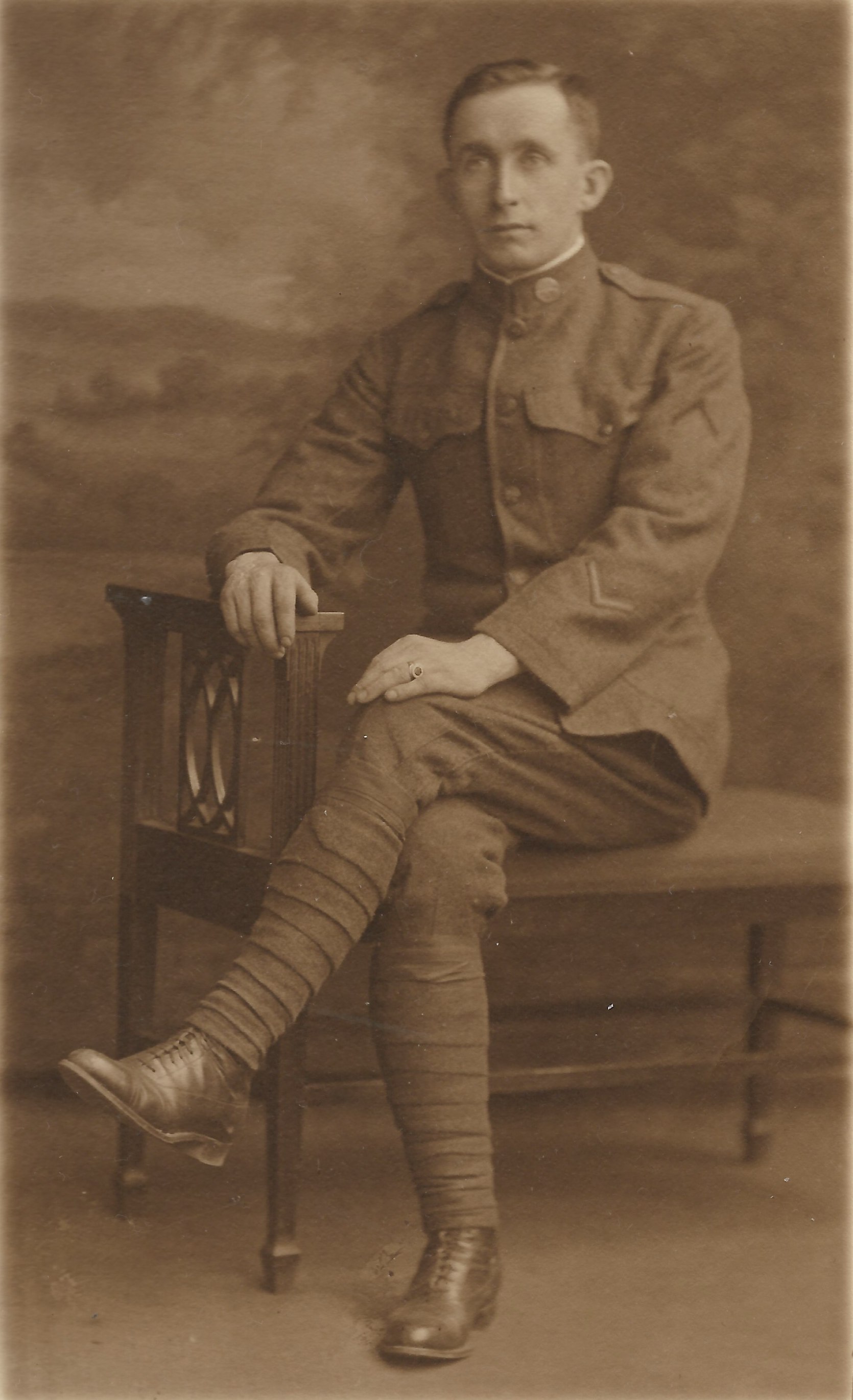
John Ware, in 1918 or 1919.

These were the dangers 31-year-old John Ware faced 100 summers ago as he joined the army and shipped off to the European front. Regretfully, I never asked him about his service before he died at age 96, when I was in my early 20s, a missed opportunity of long-ago Christmas dinners and other family gatherings.

My trip to Calvary Cemetery in Pittsburgh prompted me to take a closer look at some family documents and photos of John, with additional research. This is his story:

He was born in County Kerry, Ireland, near Ballylongford. He immigrated to Pittsburgh in 1910; worked as a streetcar conductor from the Frankstown Avenue car barn in the city’s Homewood district; and worshiped at Holy Rosary Catholic Church.

Two sisters followed him to Pittsburgh. One wed another Kerryman, who became John’s brother-in-law and my grandfather. The other sister, like her older brother, never married. All four of these Irish immigrants are buried within a few feet of each other at Calvary.

In June 1917, two months after America entered the war, John registered in the first round of the U.S. military draft. Men between the ages of 18 and 45 were required to sign up, both U.S. citizens and resident aliens who had filed a declaration of intent to become a citizen. John was already well into that process, and he was naturalized a month later.

Immigrants who had not filed a declaration of intent were exempt from the draft, but many of them volunteered for the military. The federal government soon offered fast-track citizenship to these soldiers and sailors.

John was drafted into the army on April 28, 1918. The surviving record notes his transformation from citizen to soldier occurred at 4:30 that Sunday afternoon in Pittsburgh. That day, one of the city’s newspaper headlines declared:

Allies Halt German Drive At The Threshold of Ypres

Enemy’s Slight Gains Made At Cost of Staggering Losses

The next morning, John and his address at 7115 Kelly St. were listed in the Pittsburgh papers with other “Names of Those Who Go.” That afternoon, he and 287 other area draftees entrained to Camp Lee, Virginia, a year-old combat training base south of Richmond.

Irish soldiers

That spring, Irish immigrants and their supporters were making other headlines in Pittsburgh. On May 5, 1918, thousands gathered at the downtown Lyceum Theater to protest British conscription of their countrymen without the benefit of limited domestic political autonomy, called home rule. They passed a resolution calling on President Woodrow Wilson to demand freedom for Ireland.

Rev. Patrick O’Connor, pastor of nearby St. Mary of Mercy Church, an historically Irish immigrant parish since the Great Famine, reminded the Lyceum audience of “the glorious record of past generations of Irishmen in defense of this great country.”

It was not only blood the Irish were sacrificing, O’Connor said, but also treasure. He told the story of an Irish workman earning $80 a month who had purchased $500 worth of Liberty Bonds, or half his annual salary.

During the last week of June 1918, an Irish socialite known as the “Countess of Kingston” visited Pittsburgh to debut a traveling exhibit of war items: “German Uniforms, Helmets, Military Equipment, Hand Grenades, Propaganda Literature, Iron Cross, Lusitania medal, British Battleship Vindictive Souvenir, German Prison Bread, and a Wonderful Collection of British War Pictures,” according to newspaper promotions.

The exhibit, staged at Kaufmann’s 11th floor auditorium, was intended to raise money for the Shamrock Fund, a charity for wounded Irish soldiers in the British army. Pittsburgh was selected for the debut because of the generous reception Lady Kingston received during a previous fundraising stop.

Honest and faithful

As Pittsburghers visited the Irish war exhibit, John shipped off to Europe with the 145th Infantry Regiment of the 37th Division. The unit fought through the summer and fall. John’s record says he was in the Alsace Lorraine Sector, a disputed territory between northeast France and southwest Germany.

A few more details can be gleaned from John’s military record

Wounds received in service: “None.”

Character: “Very good.”

Remarks: “Service honest and faithful. No A.W.O.L., nor absence.”

John’s tour of duty ended Jan. 30, 1919, about 10 weeks after the armistice. He was released two weeks later, on Valentines Day, from Camp Dix, New Jersey. The Army issued him $53.54 in travel pay (about $500 today) for the 350 mile return to Pittsburgh. Perhaps he remembered a similar westbound train trip as the last leg of his journey from Ireland nine years earlier.

Like many soldiers, he sat for a photograph in his uniform. The image survives with his Honorable Discharge record.

John returned to his streetcar job. For the next few years he read newspaper accounts of Ireland’s war of independence from Britain, which resulted in the island’s partition, and a brutal civil war. The following decades brought World War II, Korea, Vietnam, and the Troubles in Northern Ireland.

More death and injury.

John was luckier than tens of millions of soldiers and civilians in all those places. His 65 years after WWI was twice as long as the life he easily could have lost in France that perilous summer 100 years ago.

Tending his grave at this year’s centennial seemed the least I could do.

Grave of John Ware, Calvary Cemetery, Pittsburgh, June 2018.